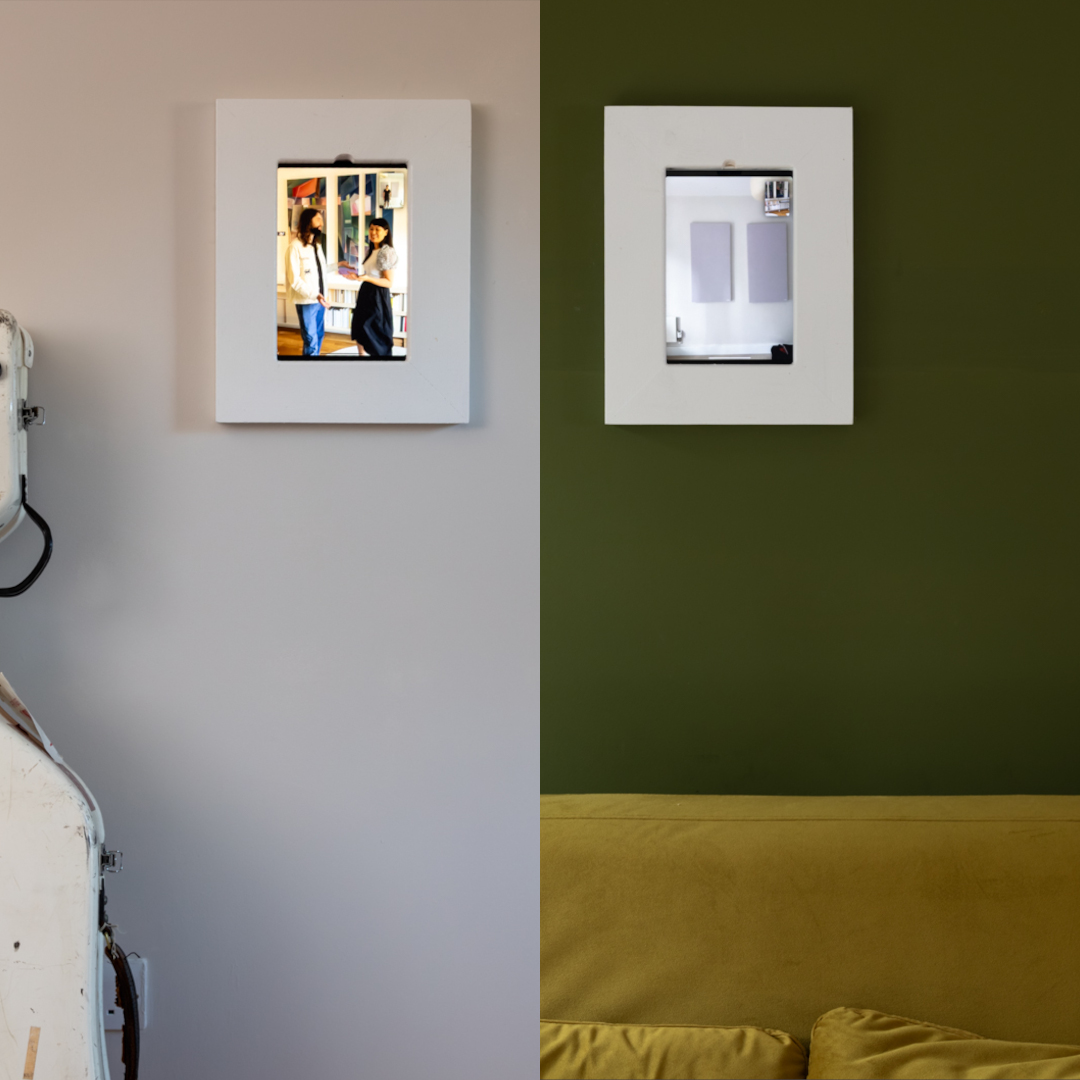
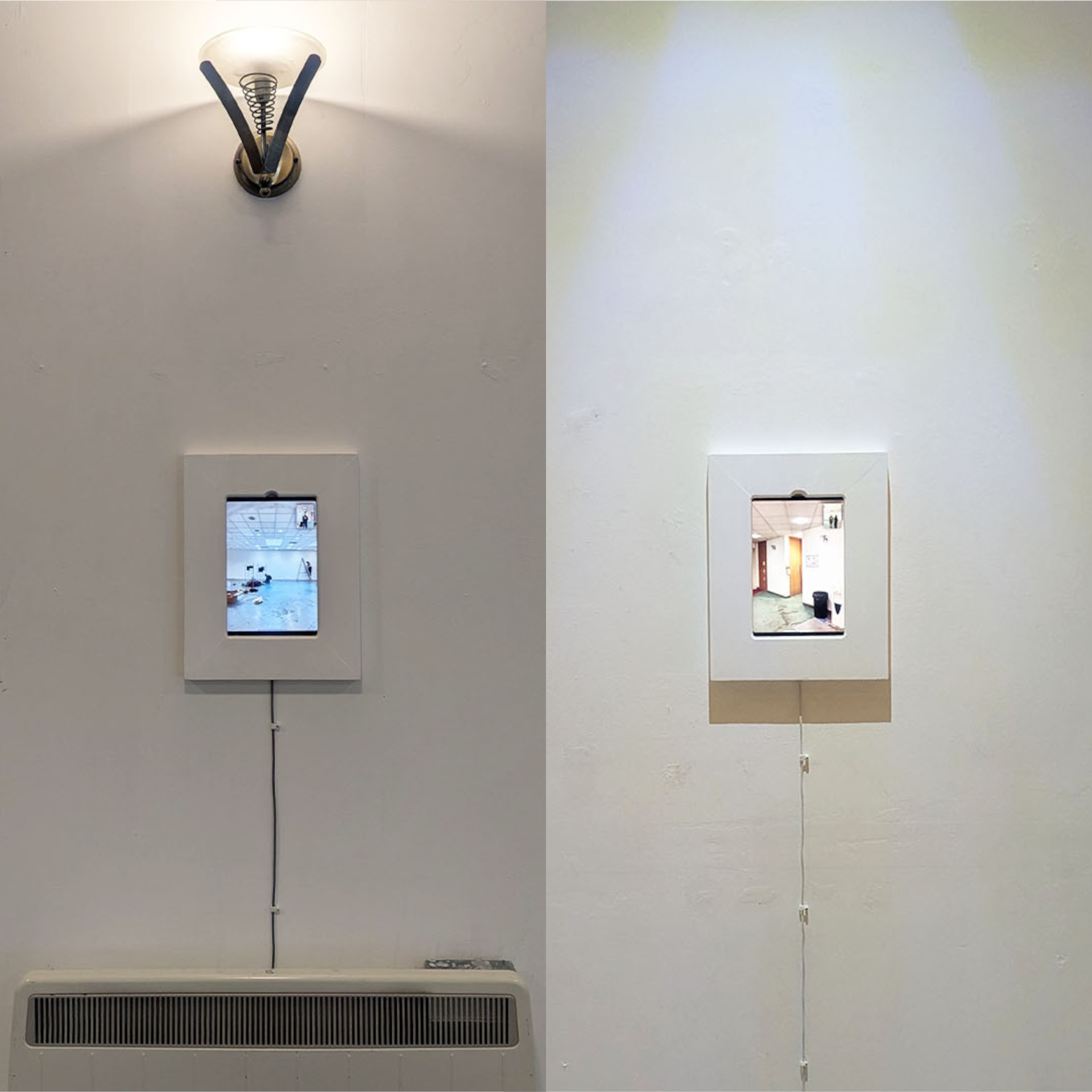
My 2026 artistic year really started last August with my piece for APT: Thresholds, the third and final apartment show I curated with my collaborator Miso. I had envisioned a window through the walls of the flat crafted by an internet connection that utilised the infrastructure of a city. My assertion was that the connection between two iPads, 30cm apart either side of a wall, would need to at some point handshake with Apple to authorise both users and route the traffic. This would mean that to cross this wall, data would be sent to the Wifi router, over copper cables to a local exchange, via fibre optics to the Internet Service Provider’s core network, onto the London Internet Exchange, to Apple Edge Servers in a London datacentre, and all the way back again. This piece Window asks a question about the interiority of digital spaces. The conversation of a FaceTime call within a singular house is totally confined to the house, but the data and mechanism would require the infrastructure of a whole city, stretching what interior is in this context. There is something non-geographical in the sense of interior, ideas of encryption and privacy are also factors in its determination.
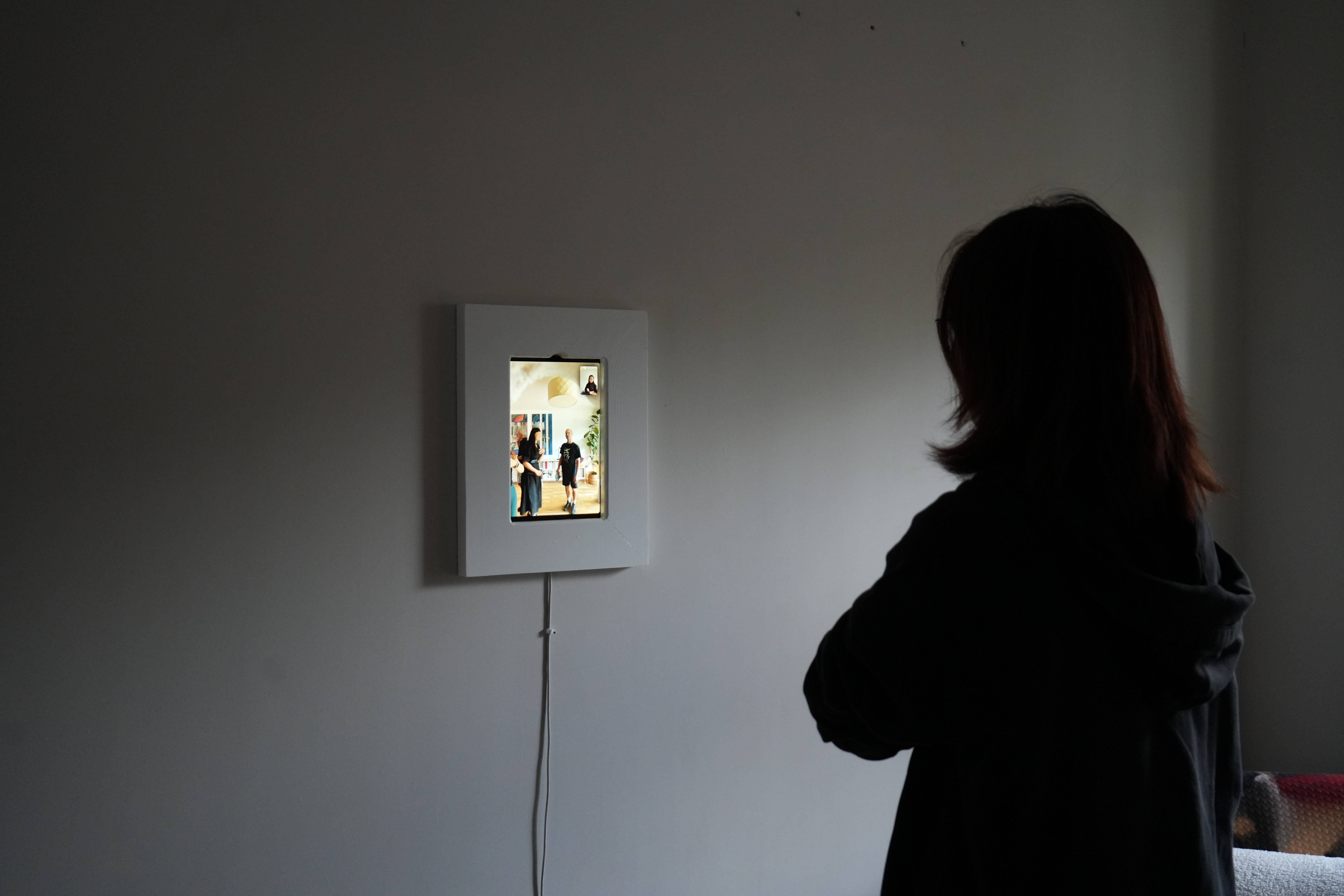
I was invited by Phreaking Collective to take part in their exhibition Does Cloud Compute ever Precipitate at ANNEX by Koppel Projects. Phreaking are such a wonderful collective and they invited me to further participate by giving a talk on the subject of Window and network infrastructures. As part of this I traced the very route that would be taken between the two iPads to say hello to each other and participate in the call. A write-up of the talk can be found here. Sadly I found out that my assertion on the connection infrastructure required was only half right. The FaceTime routing algorithm will attempt to use the lowest latency network connection it can. The first attempt to connect from a new network will require the data packet to travel all the way upstream to an Apple edge server, but after this, the ip locations of the two iPad nodes is known and so the video will take the shortest route it can. In the example of Window this means that after the initial connection, the video feed is actually remaining on the same network.
This process of mapping and my interest in the infrastructure of the internet in London led me to finding cellmapper, a service that shows all the known internet antennas in a given area. I have been on and off trying to use this service to track all the cell antennae I have connected to, though I have not yet been able to retrieve and sift through the data.
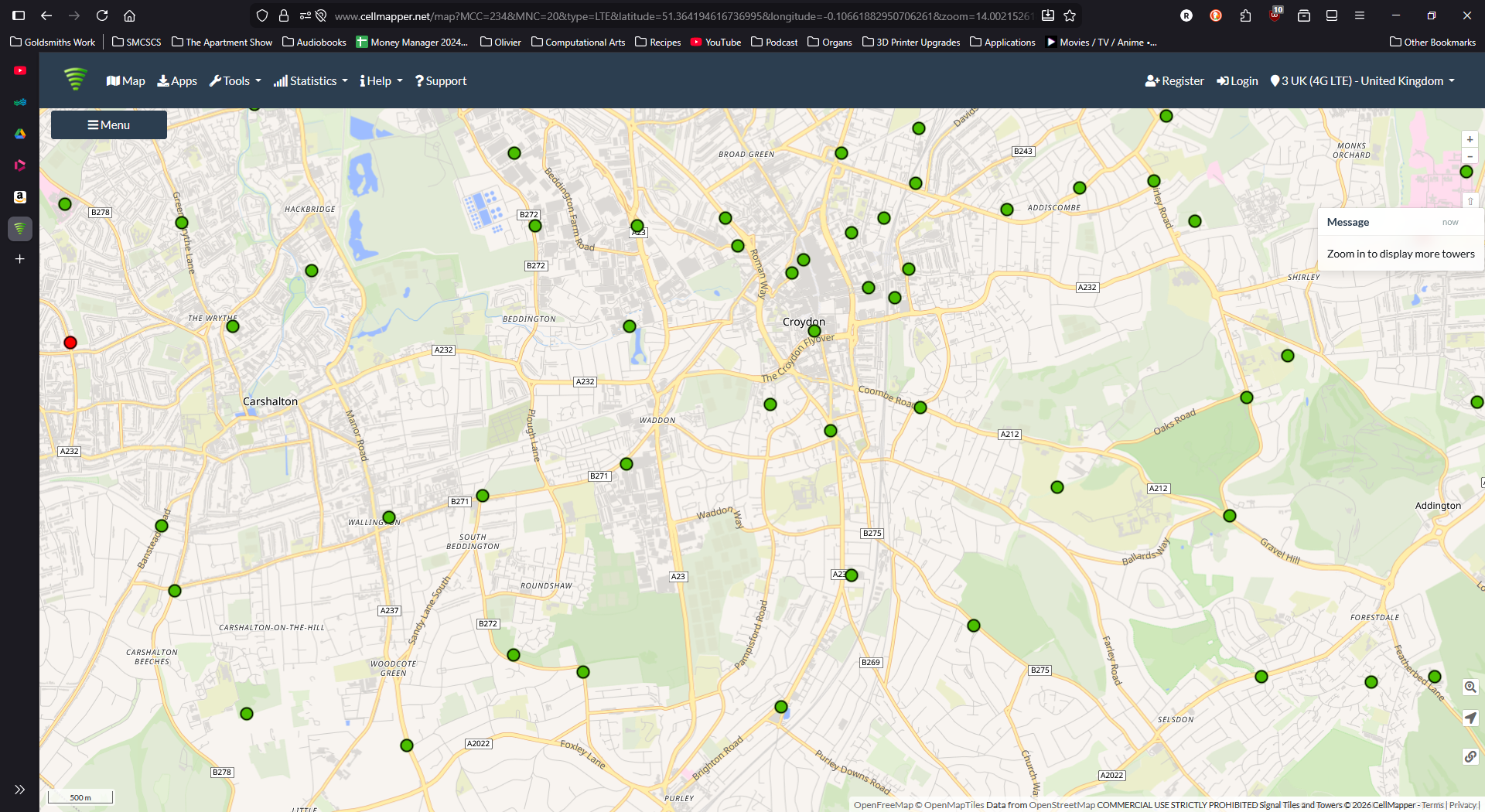
With this information I was able to map every antenna known in the Croydon area around my house, and between the two datacentres at Pulsant and CapitaLand. These two datacentres are landmarks of interest from the past year as I have been made more aware of the impact of datacentres since the birth of the AI boom. I gave a talk at Tate in 2025 as part of Tea, Tech and Exchange on the water and power usage after having listened to Paris Marx’s Data Vampire’s series and my own growing concerns with this form of infrastructure.
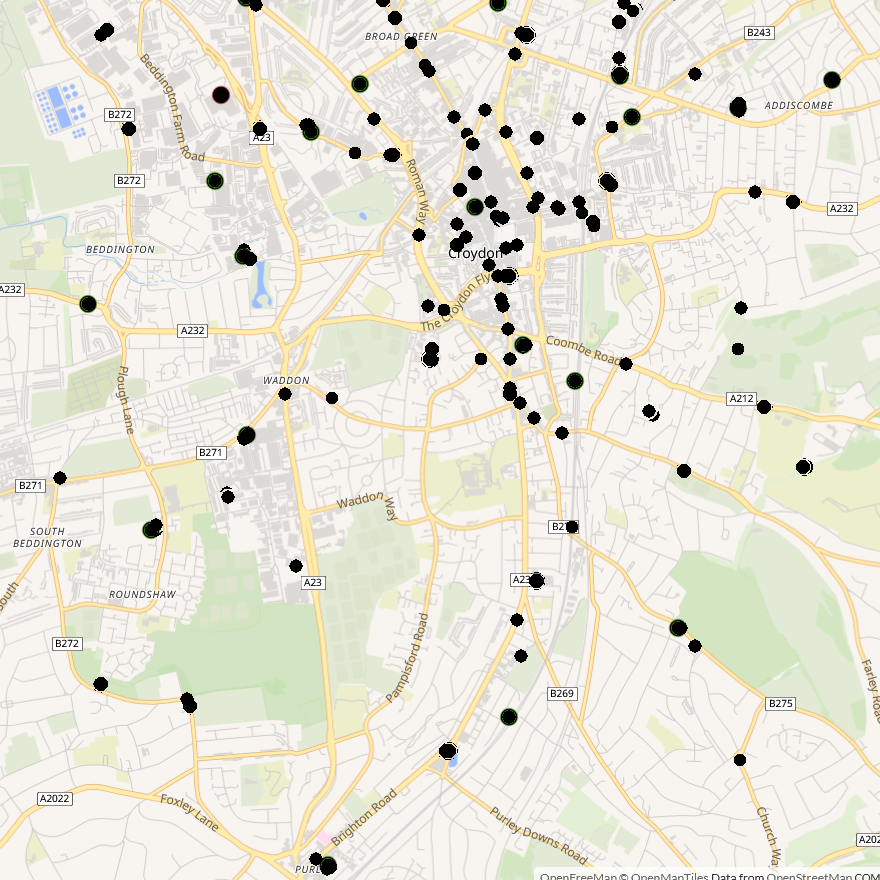
I would say that this concern has matured somewhat, perhaps into something less socially conscious and more selfish. There is interesting work done by people such as Benn Jordan looking at datacentres as acoustic weapons on communities, and the more these sorts of municipal scale effects accrue from these featureless boxes, the more I’ve become fascinated with them as artistic horror. They are immense densities of information, the closest thing to black holes that we’ve truly managed to create. Their impenetrability from a physical point of view, the architecture of these spaces is incredible in its utter dullness. These are the grand temples, or perhaps the pit mines of modern resource that the unfathomable wealth of the tech oligarchs is founded, and yet they’re just these big sheds, full of again, boxes, blinking boxes of thinking machines. In the future I’ll collate all this thinking into some form of writing, this is an aside to explain why these two datacentres near me are points I wanted on my map of Croydon.
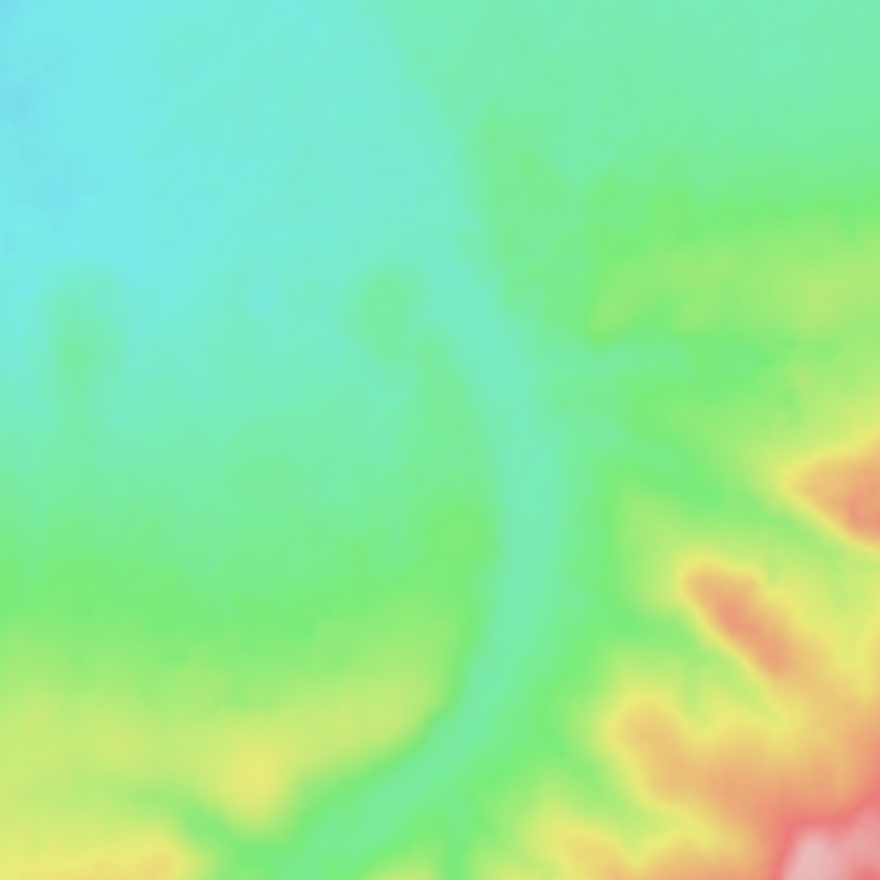
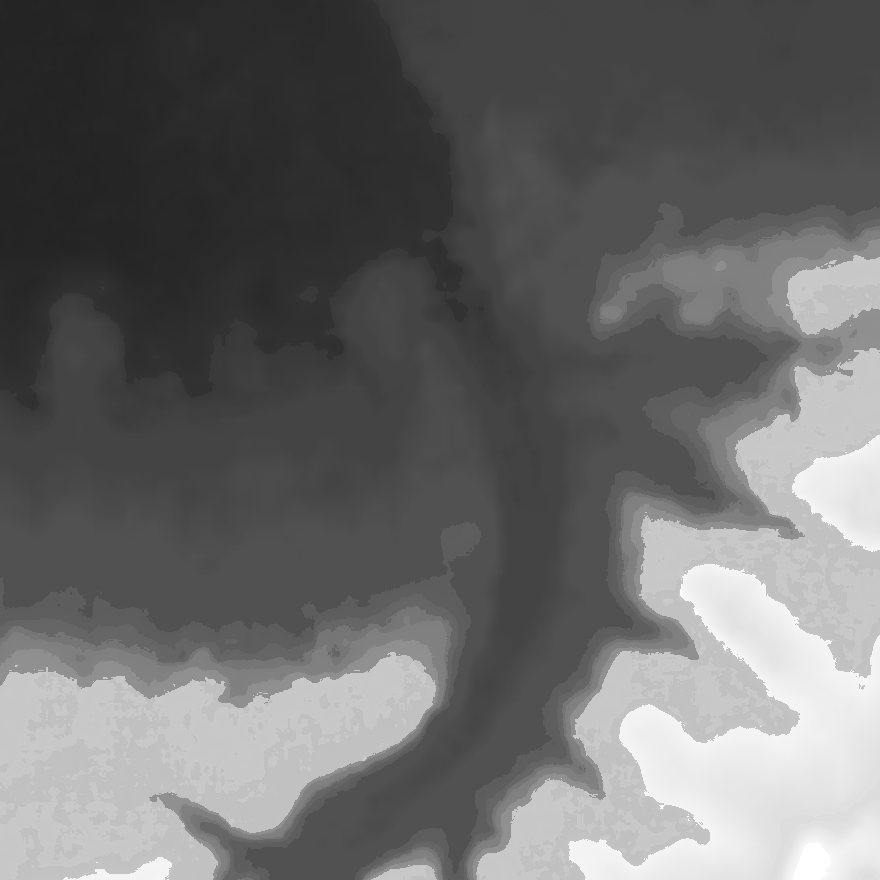
From this same map section on cellmapper, derived from openstreetmaps, I was able to extrapolate a topography of the area that could be used as a heightmap in blender to displace the surface of a plane, giving me that topography as a usable mesh.
With a little modelling of a simple cell antenna, I created these 3D visuals of antennae over Croydon in Blender.
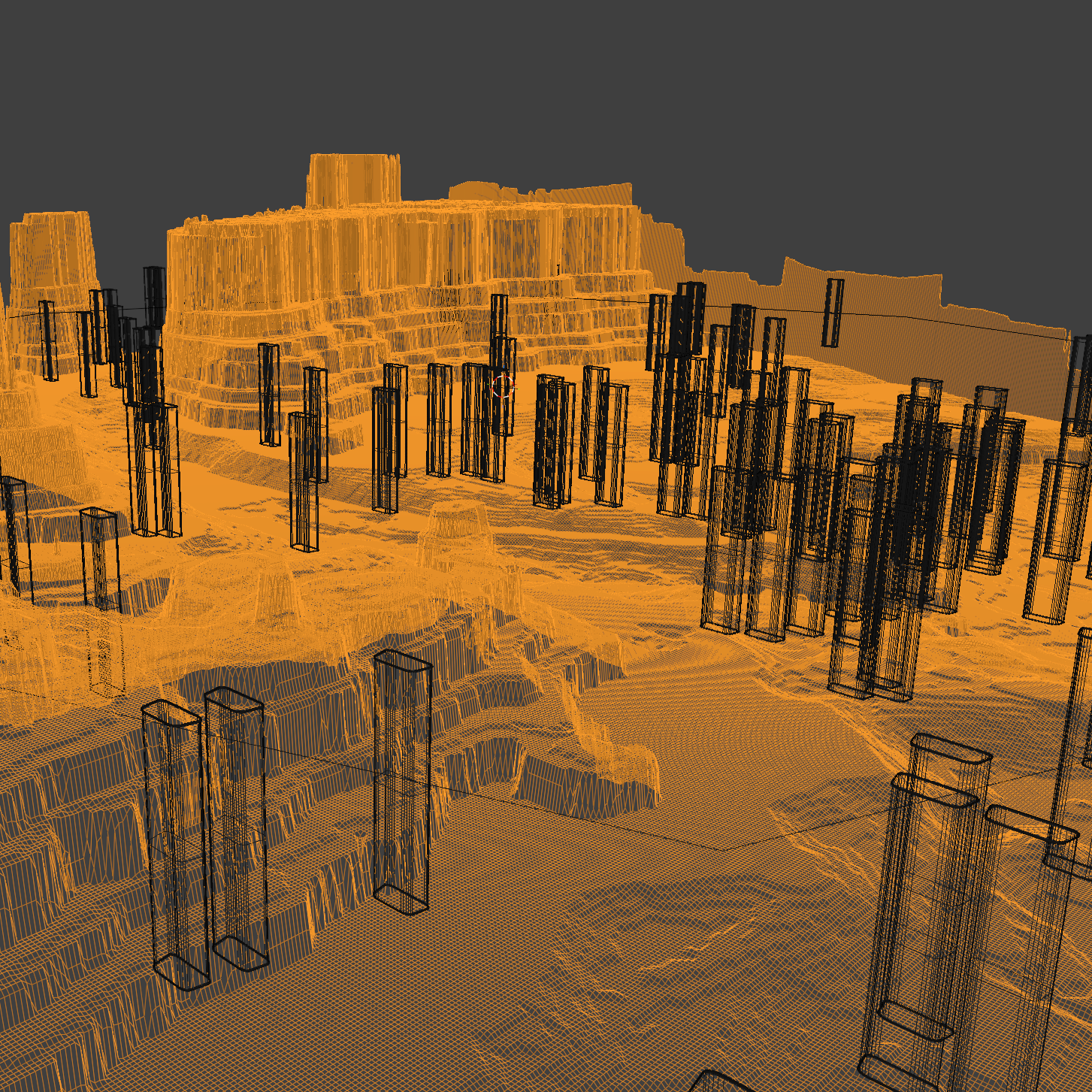
The orange of the selected wireframe makes for cool 90s visuals. The landscape is highly exaggerated, and irl the antennae would be various models and facing all sorts of directions.
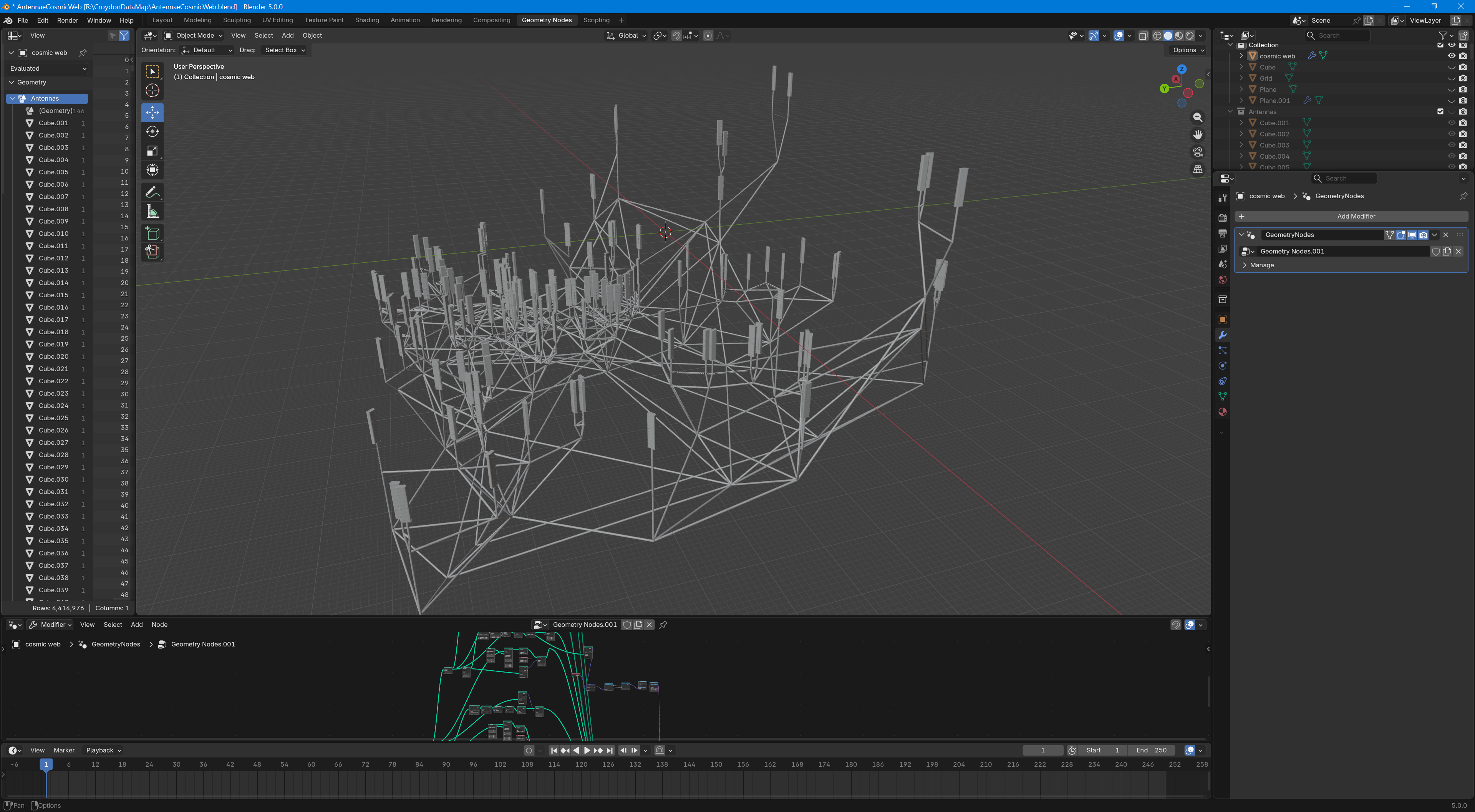
My aim from this point was to create some sort of physicalisation of the network, an artistic representation of the connection between all of these without it being a translation of real data-mapping. I think it might be possible to trace the actual infrastructural connections going on here but then it would be an activity of surveying, and data-visualisation without an artistic gesture being made. Not that my outcome was necessarily successful in this last point, but just to explain why I took this approach.
My thinking was to create a substructure in Geometry nodes. Thinking back now it might have been an attempt to (or it could be a direction for the future to) create a structure reminiscent of those on top of buildings that I have been so fascinated by, but on an absurd scale with a referent to real-world distribution. This involved clustering antennae groups by distance and then extruding a pipe to a midway point. The thinking was that this could be a sculpture of some kind. It would be difficult to 3D print such a thing however, and there is a feature of the exactness of computationally derived sculpture that leans me away from trying to re-create physically with non-digital production methods, but it might be worth a revisit.
As this project was beginning to gestate, I was sent an open call by way of a friend for this exhibition New Heretics, to take place at House of Annetta, just off brick lane. My very loose proposal for an installation about these subjects of cellular antennae was accepted, which left me with a month to scramble together a rather large installation from scratch.
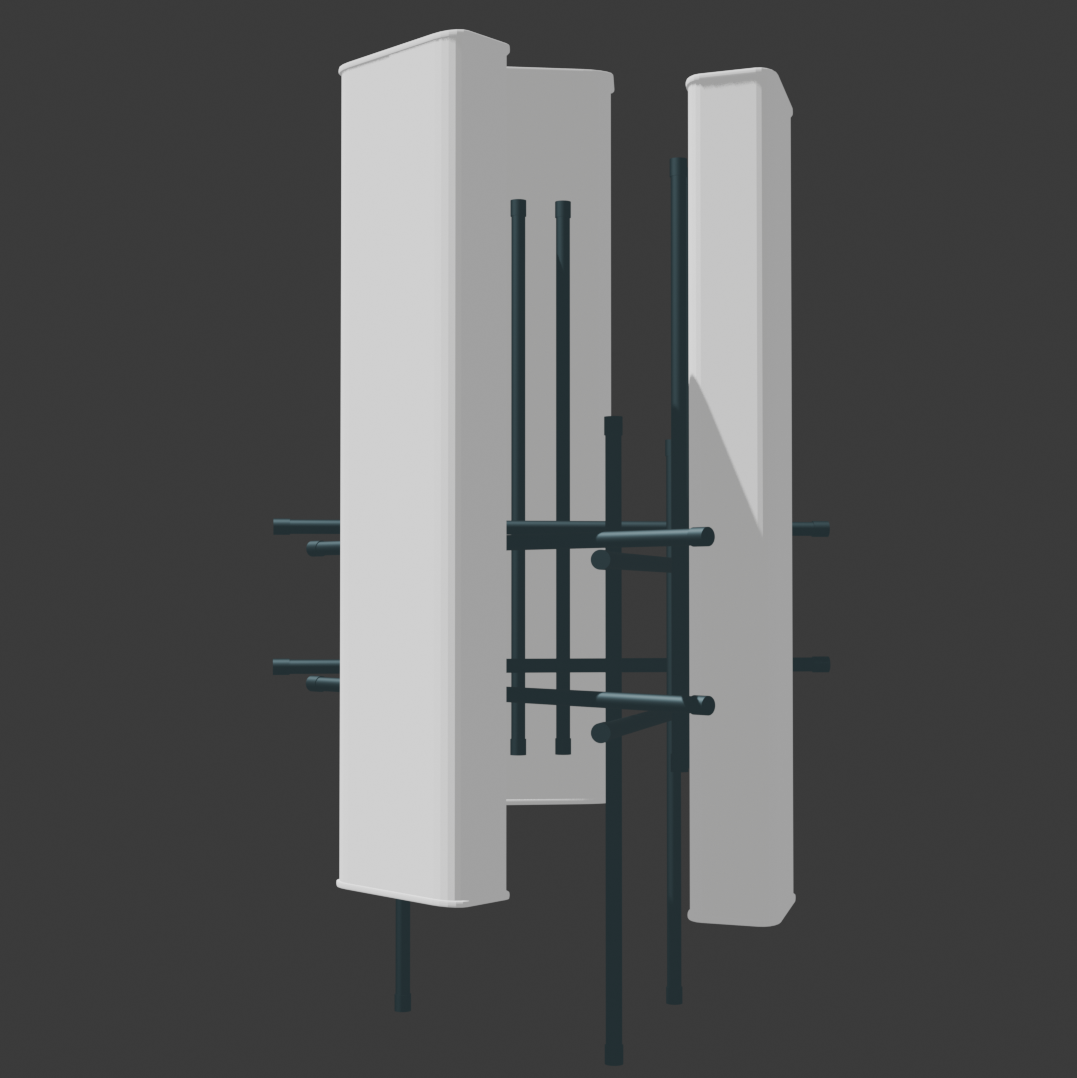
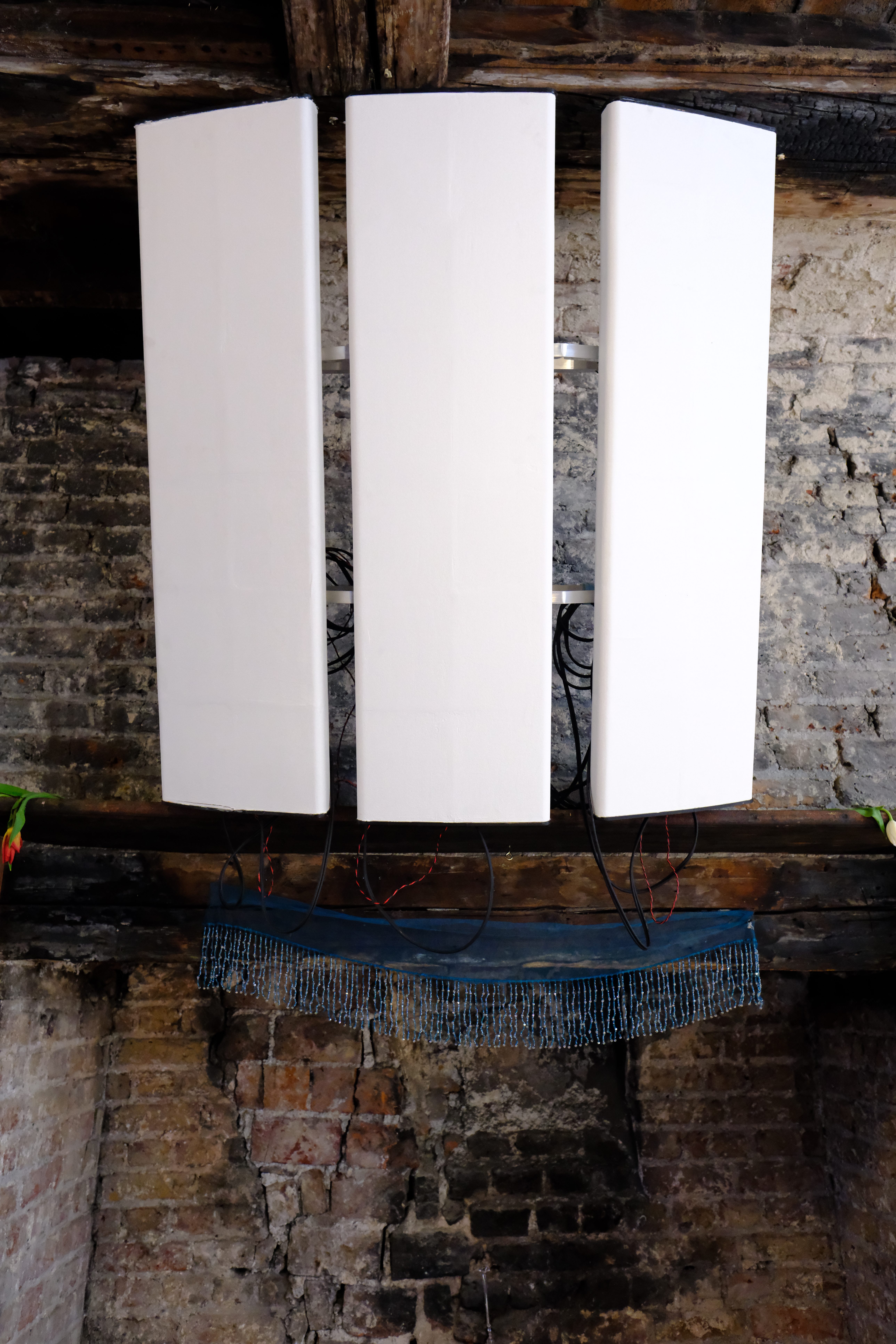
What came to mind was to create a scaffolding-based tower, which would hang antennae each fitted with speakers to play noises of urban environments. The scaffolding was to reflect the parasitic architecture that these towers seem to grow on top of buildings within the urban fabric.
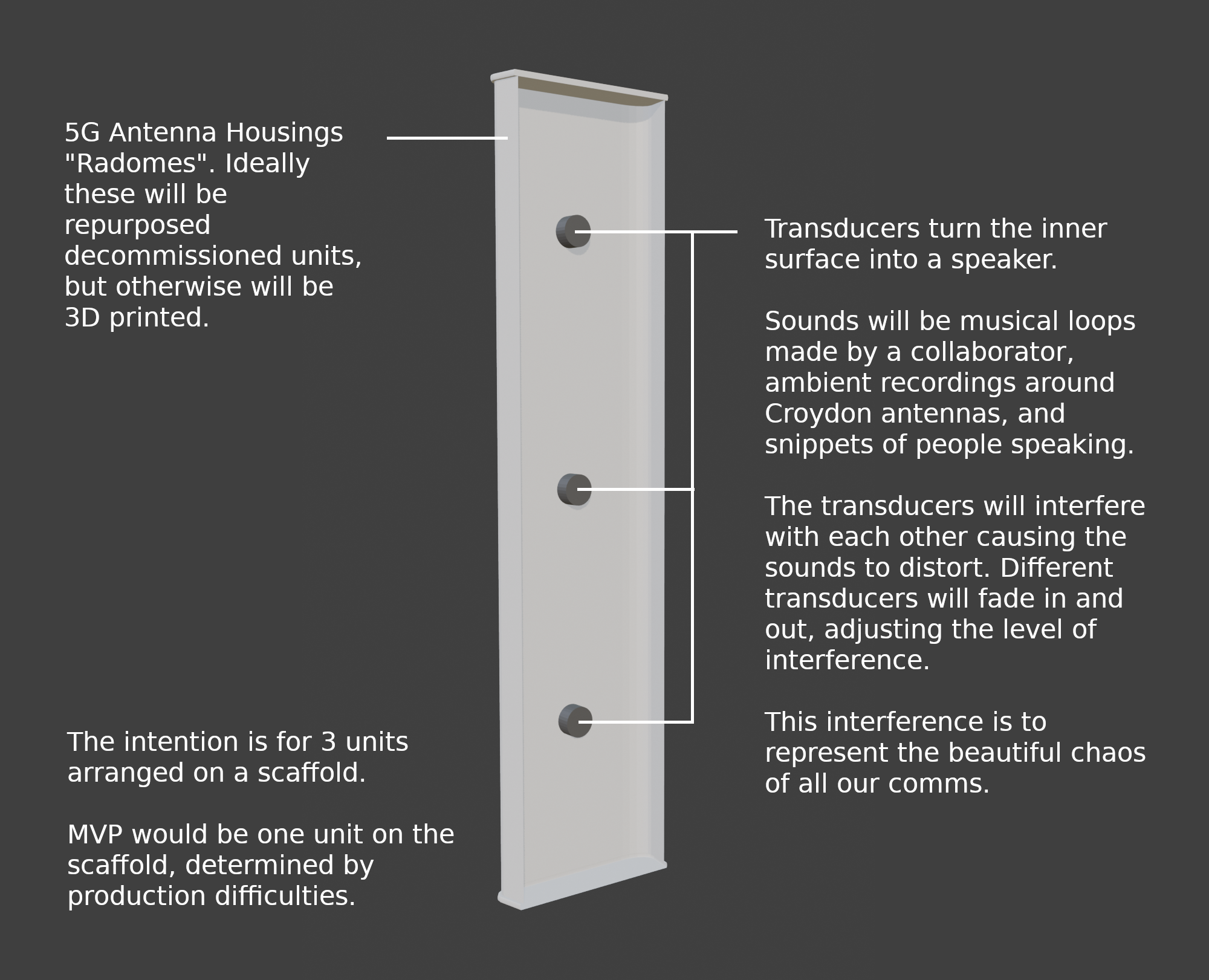
I attempted to source radomes from disposal companies, but had no luck. The fibreglass shells would have been great for their rigidity, weight, and resonant qualities to carry the sound. My solution for the sound itself would be to use transducers, turning the entire surface in effect into speakers. My hope here was that the sounds from different transducers would interfere with each other adding distortion as sounds attempted to layer overtop of each other. In the end this didn’t really happen and the sounds were able to be distinctly heard alongside each other, which I think is down to a lack of understanding how speakers really function on my side.
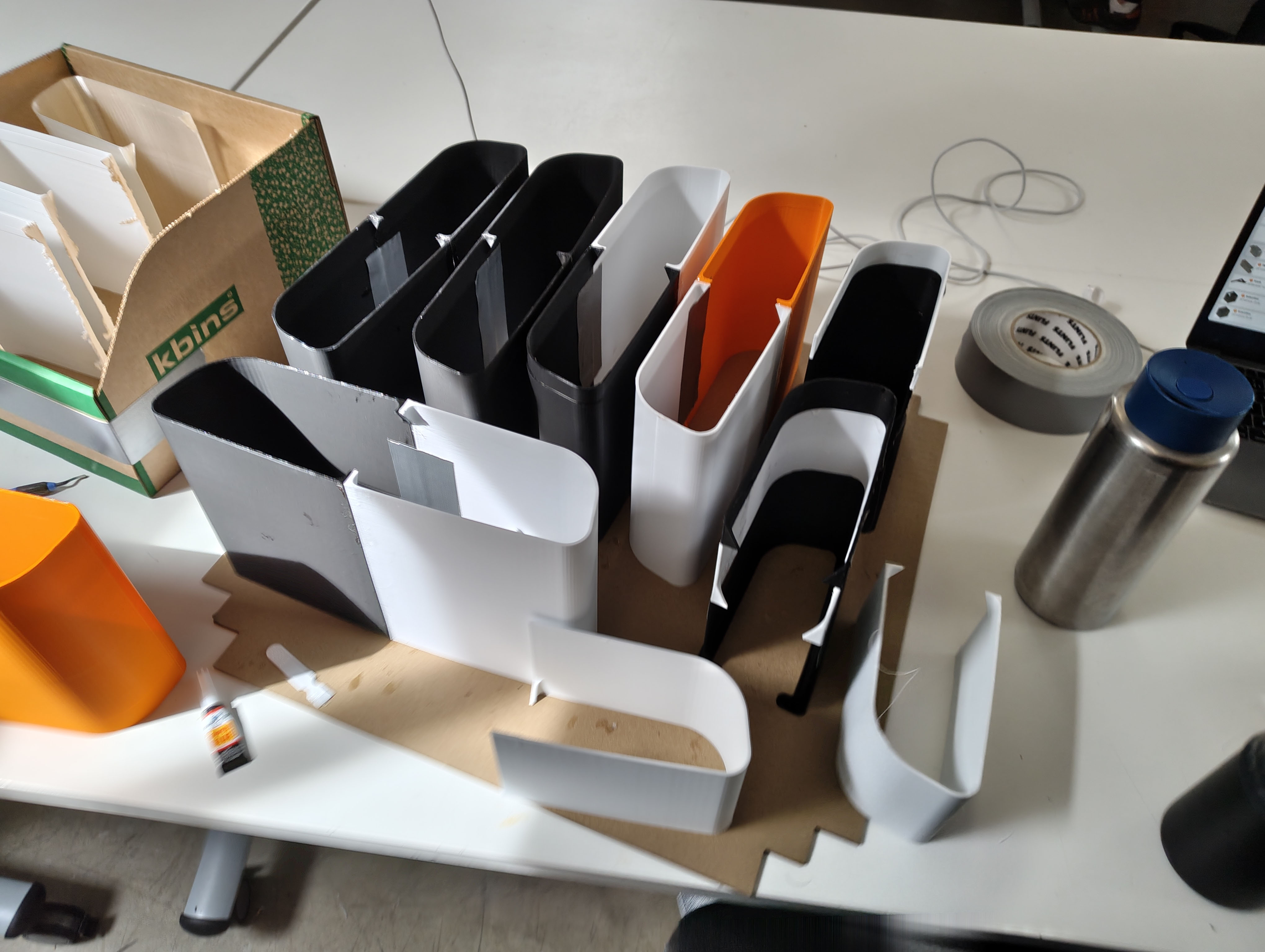
With the lack of success in finding retired antennae and the pressing deadline, I began working on a 3D printed solution to the radome housings.
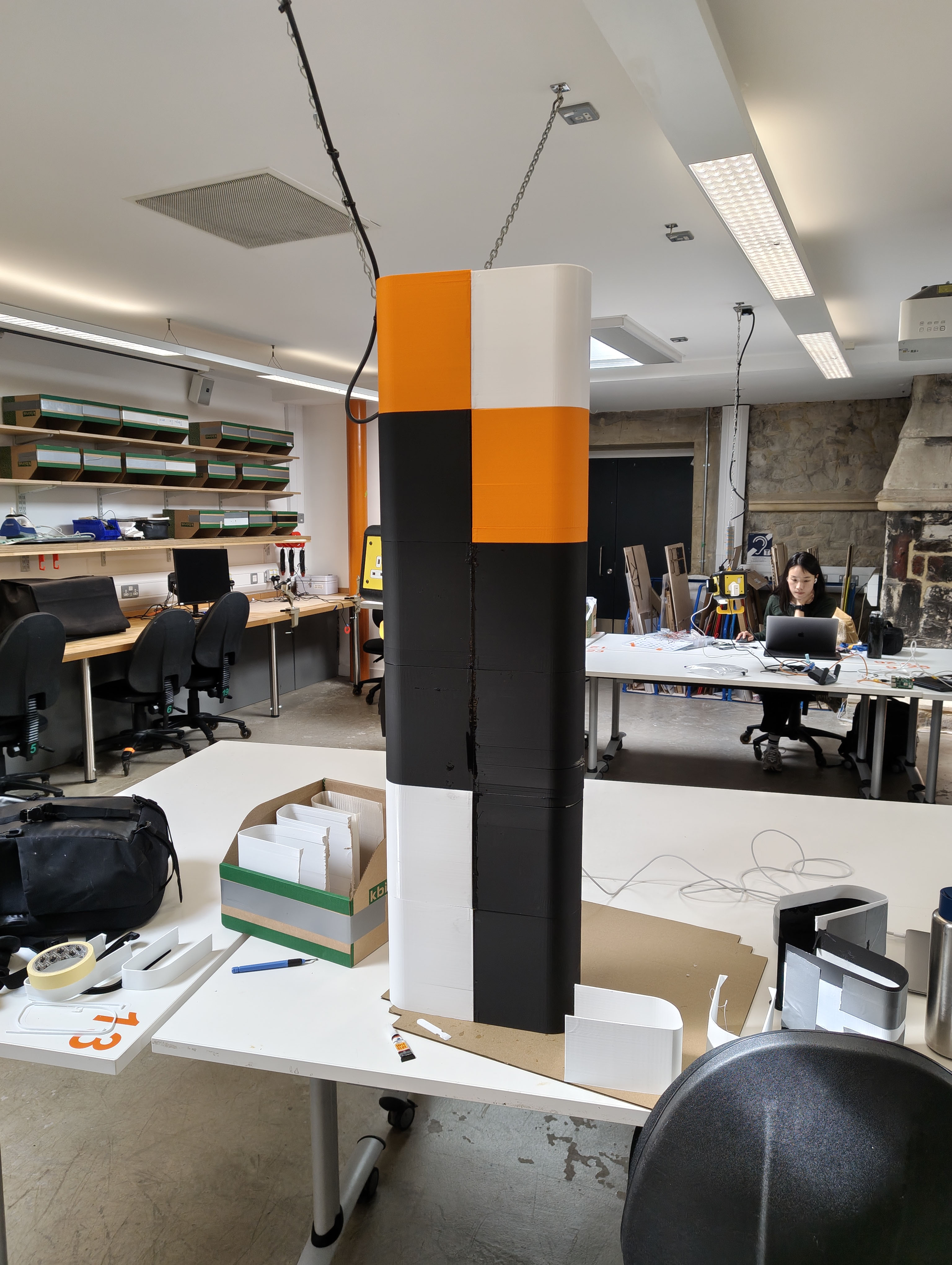
The plastic came together with epoxy, but it was a lot of printing to get enough for 3 antennae.
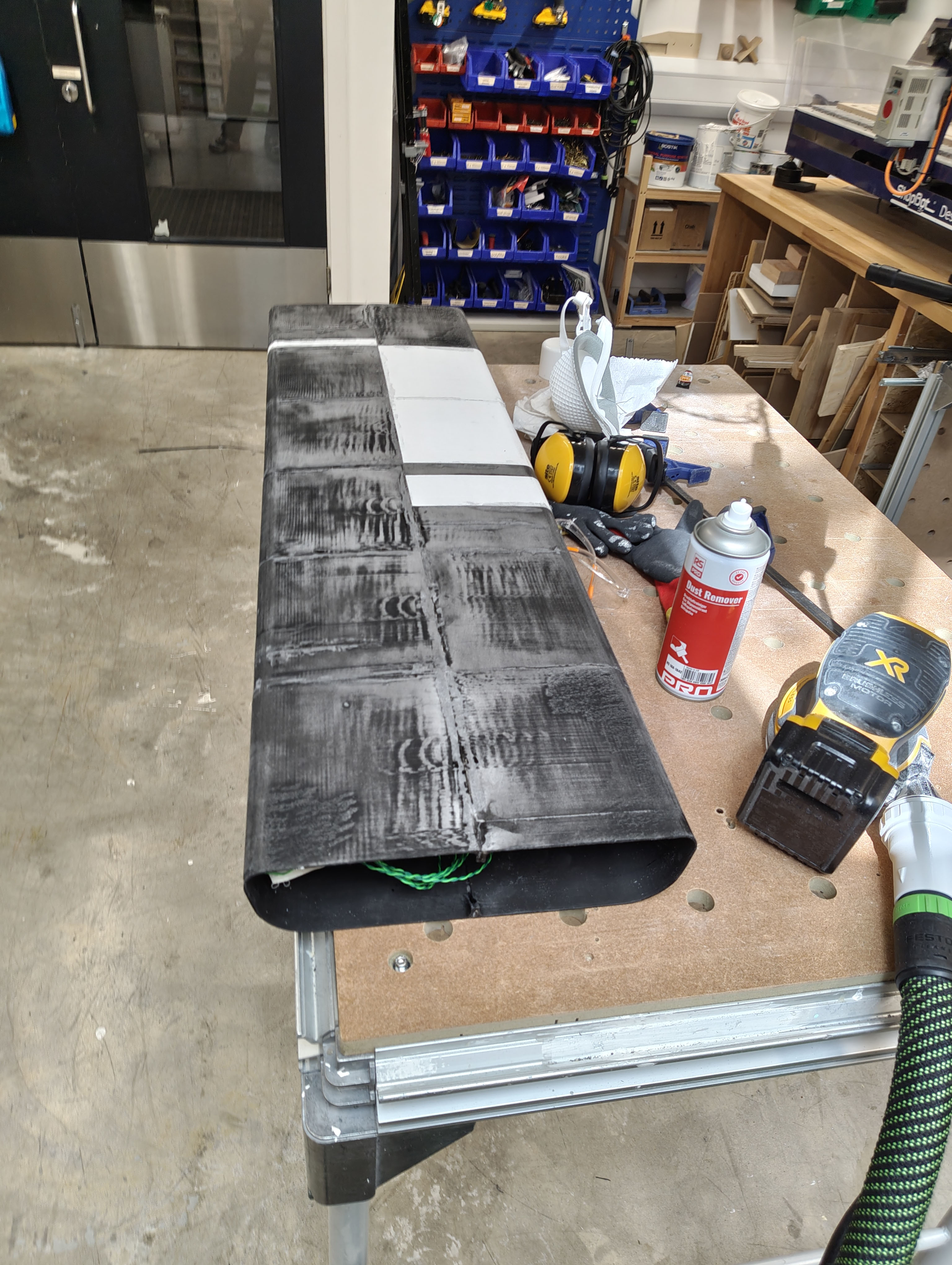
I spent a week purely on sanding and filling and sanding and filling, trying to get the surface to where I wanted it to be.
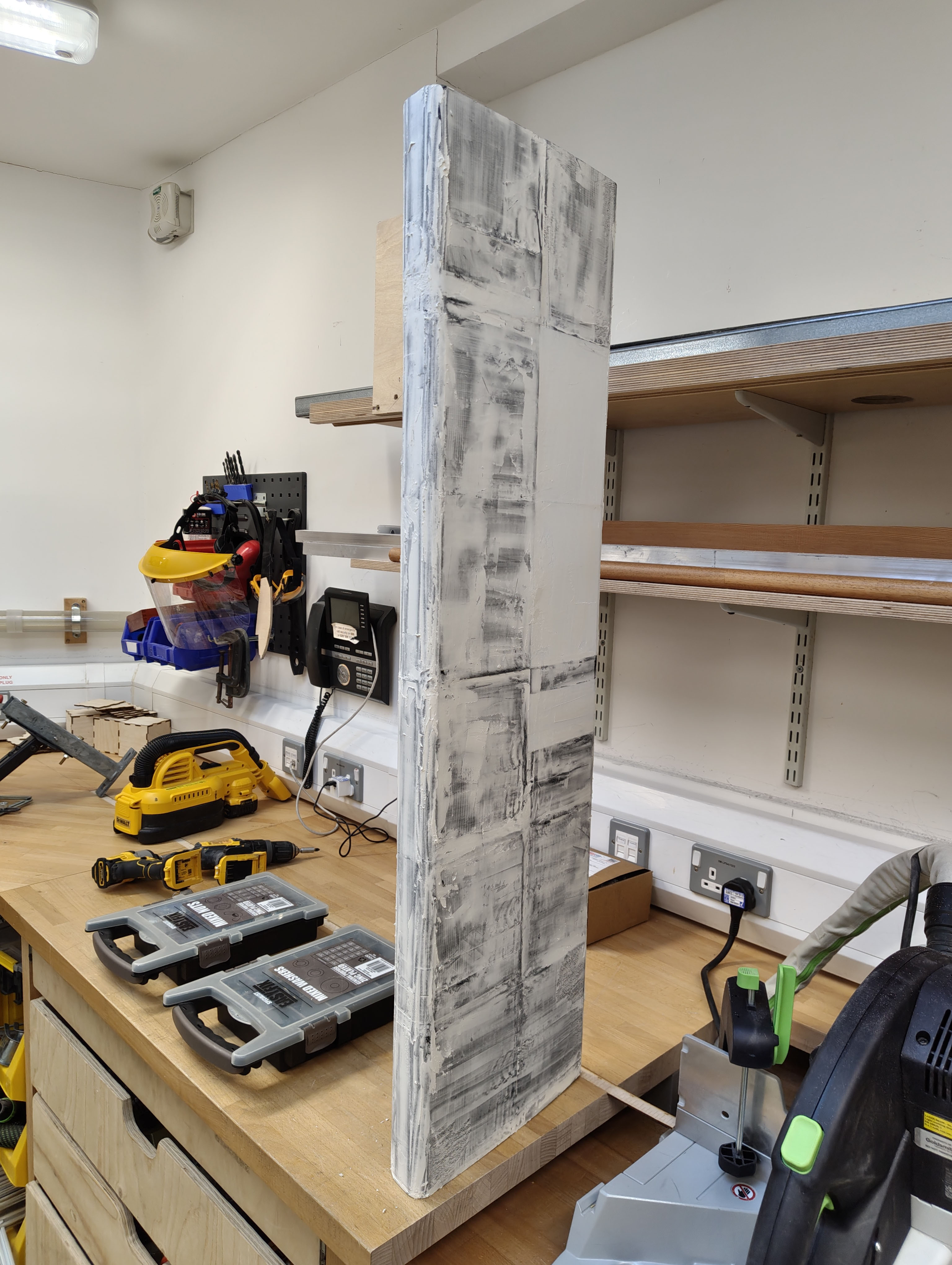
And then disaster struck! I took the towers out to an area that would be okay for spray painting, ready to give a primer layer. The primer was barely making any coverage and then the wind took its toll and my poor towers all fell over and broke.
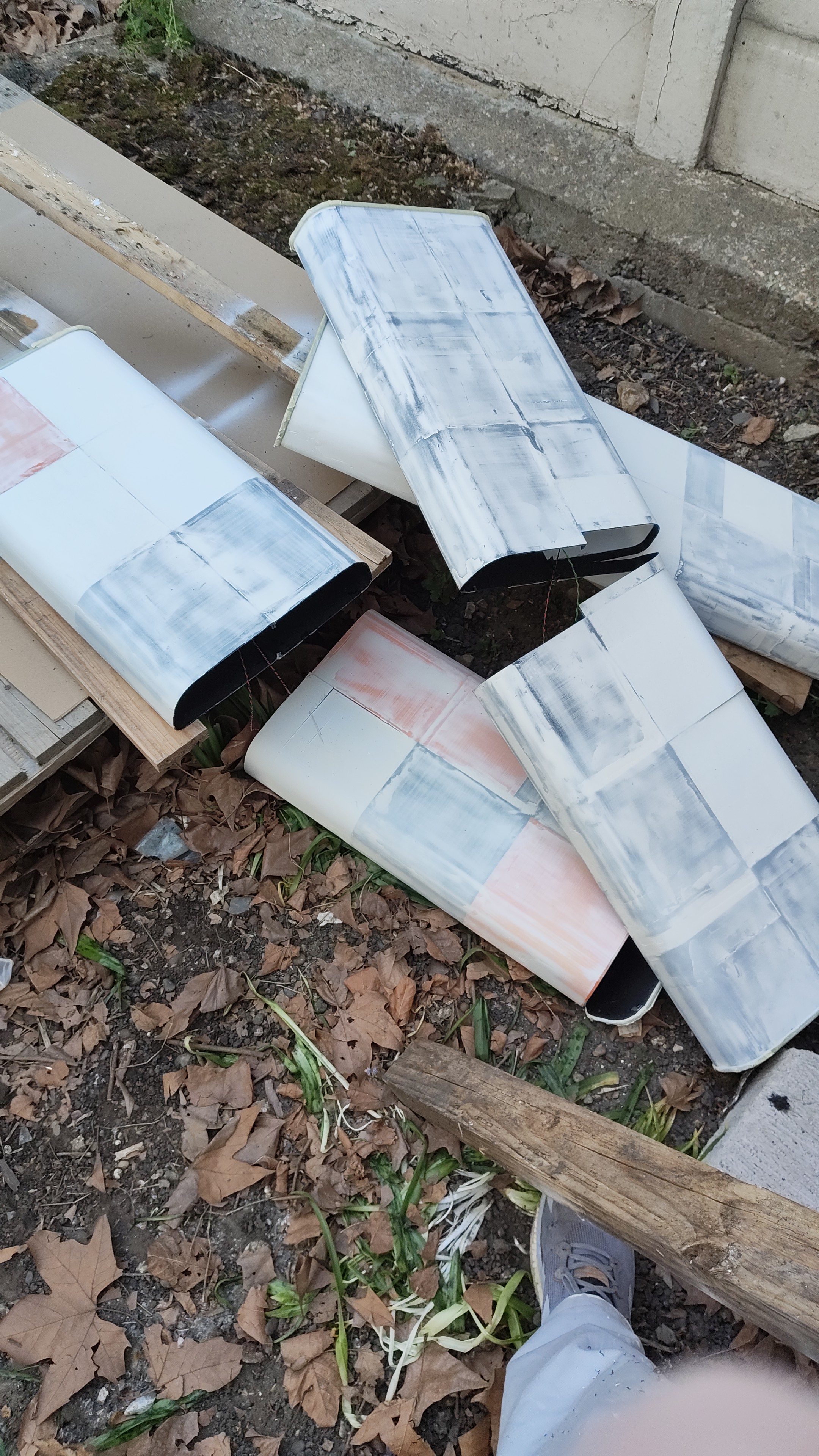
This was a result of poor design on my part, there had been no internal buttressing and there really wasn’t sufficient surface area to glue them together. I had previously planned to add a layer of fibreglass to the outside and give a proper strong surface, but had been told this was not going to be allowed in the lab.
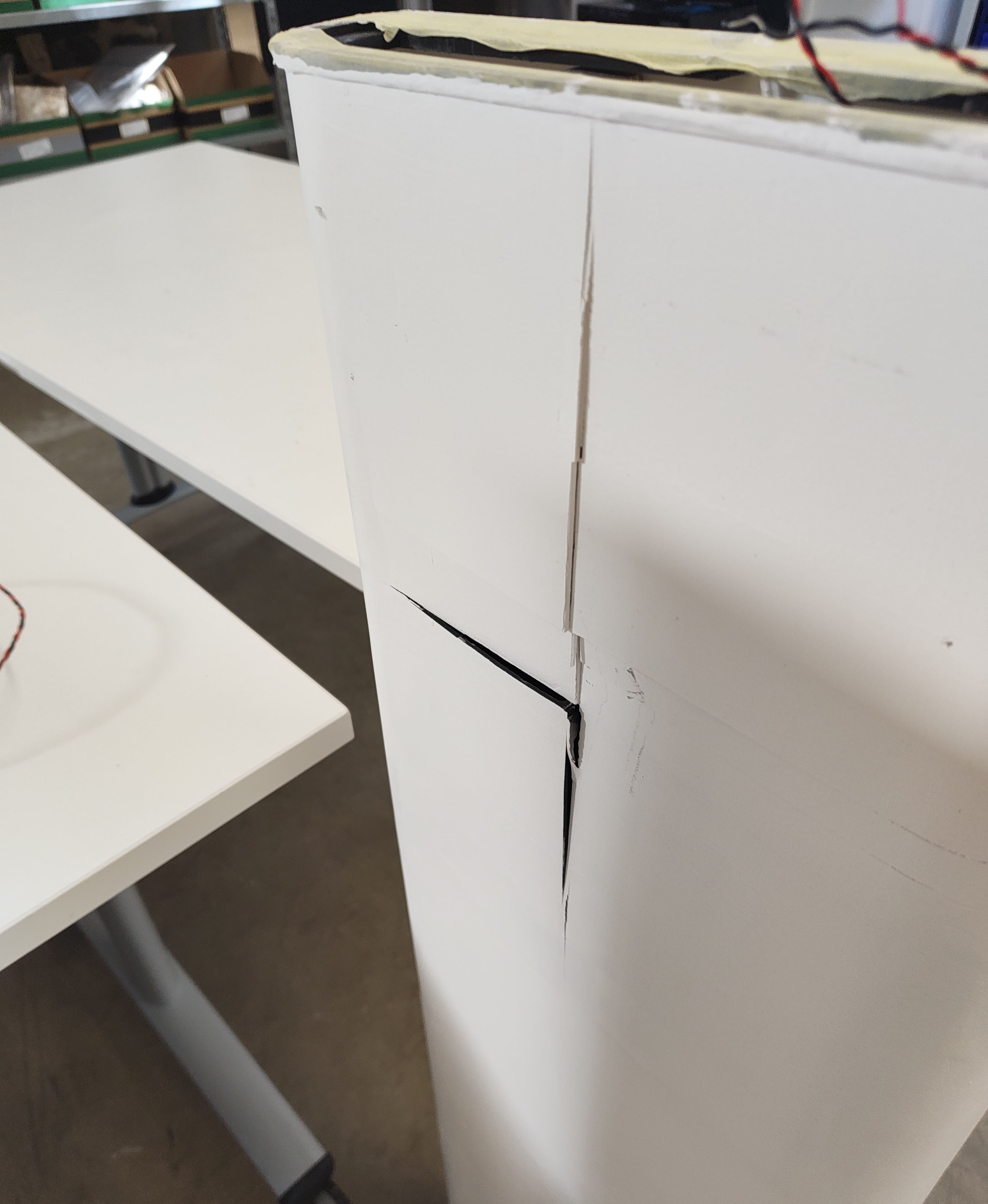
With some wooden stakes, I brought them back together, stronger, re-glued and filled the affected areas and applied a layer of paint… which as it dried added stress to the plastic and cracked it massively again.
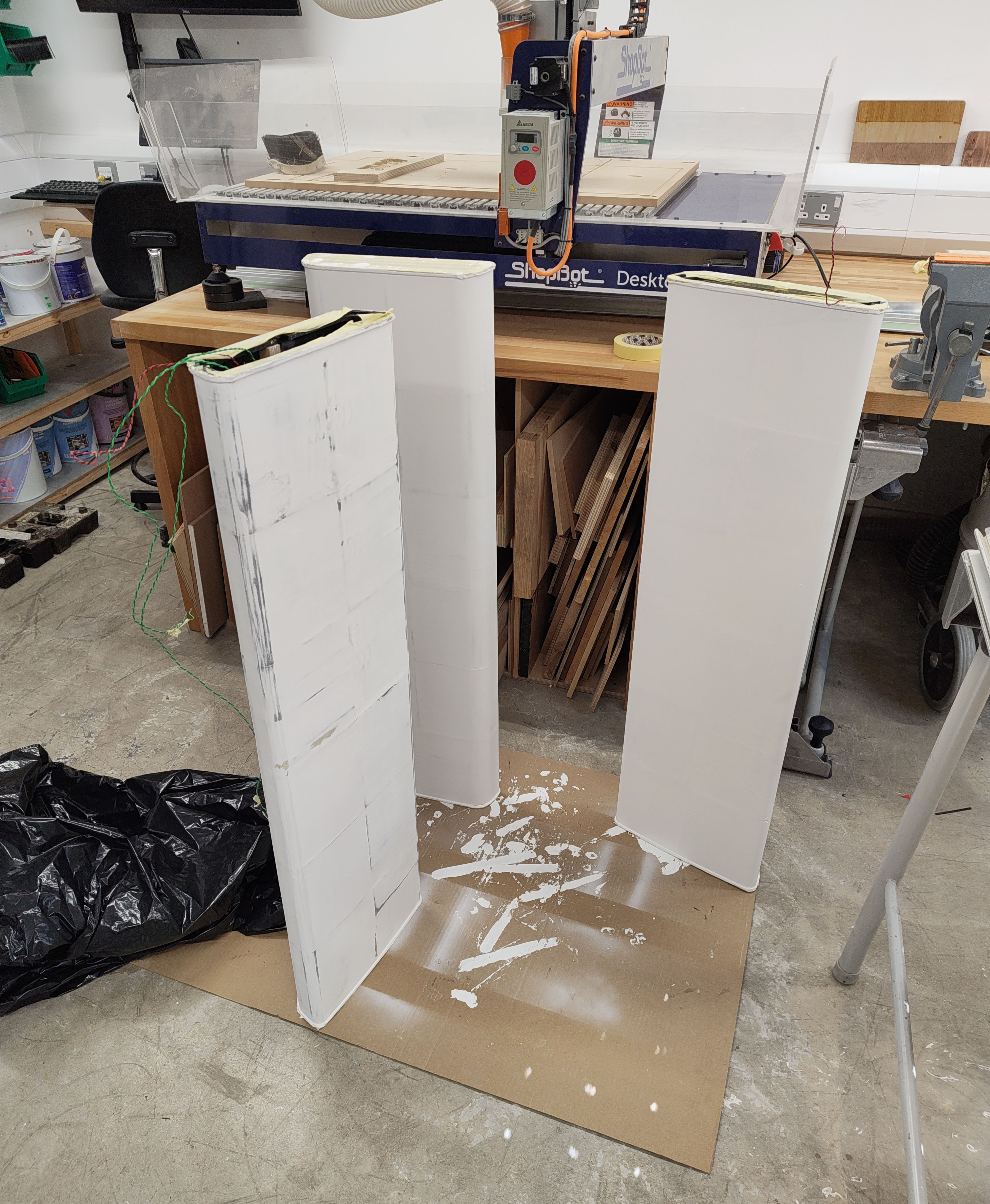
Glueing, filling, sanding, painting, sanding, all in a rush now with installation the other side of the weekend.
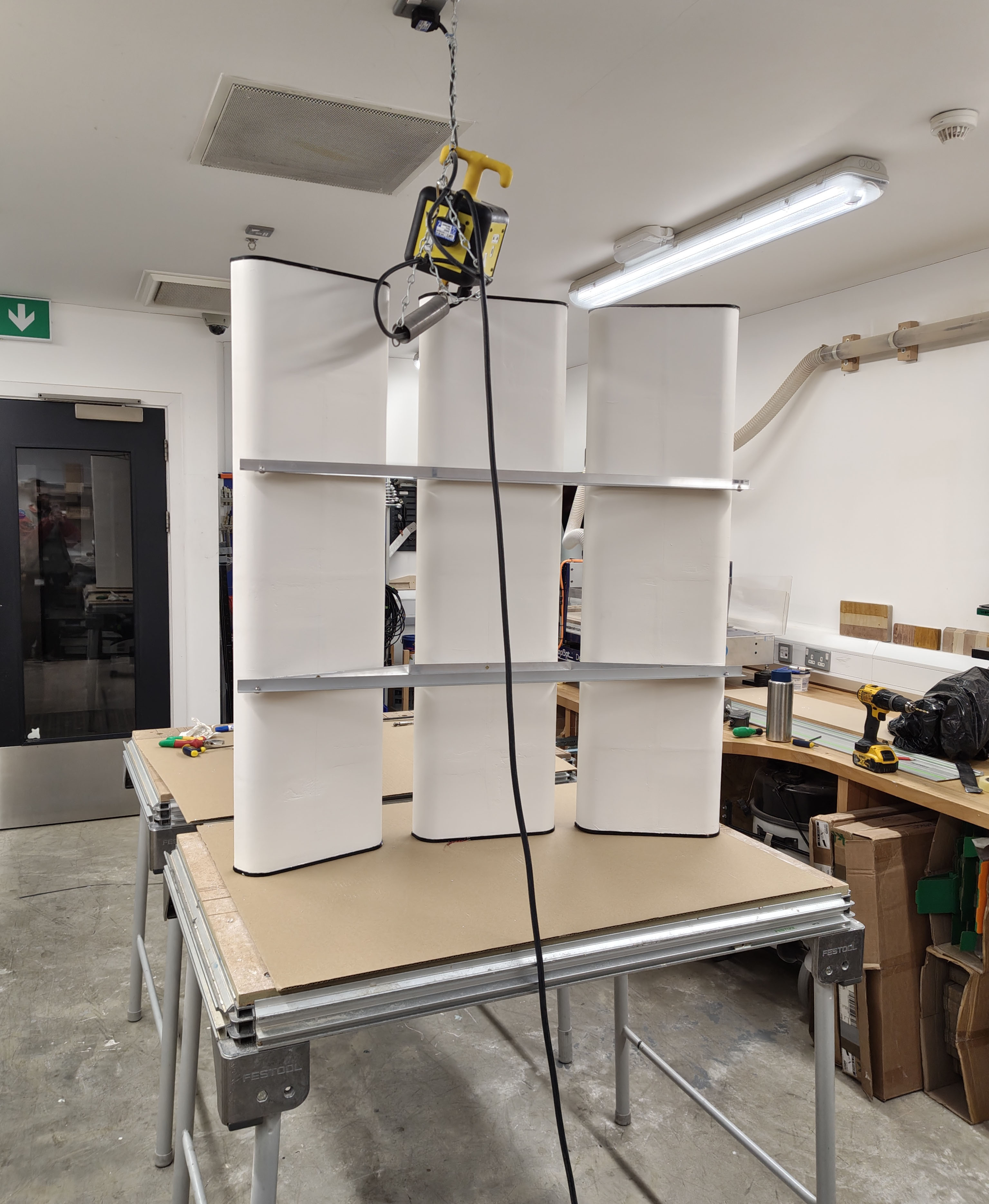
The final details necessary were to create the hanging system, some aluminium brackets bought from B&Q that I cut little triangles out of to bend appropriately for how I wanted to display.
The sounds element of the work was to work on 3 levels of samples created by my collaborator Alex Rule. Firstly would be musical loops Alex had created himself, soft, often ambient, often dark beats. Secondly would be vocal tracks, bits of people talking, radio snippets from his vast record collection. Thirdly would be ambience of Croydon, from the trains, the car boot sale, the streets. The purpose was to give this feeling of all these bits of information of public noise competing for space and being received and transmitted by our cell towers.
Everything was managed by a Pure Data patch. I have been trying to move my tech stacks towards free and open source as much as i can over the past year, and so moving to PD away from Max when I do not use Max enough to justify a subscription seemed like a good idea. I can attest it is less intuitive, but I was able to pick it up enough to do what we needed.
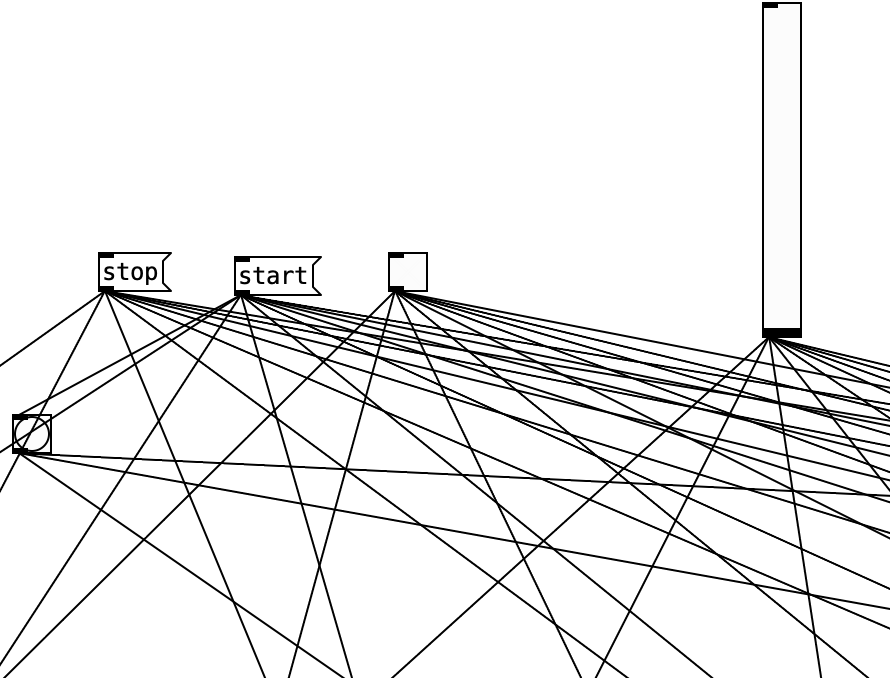
This first image (above) is effectively the master volume, start and stop of the whole patch.
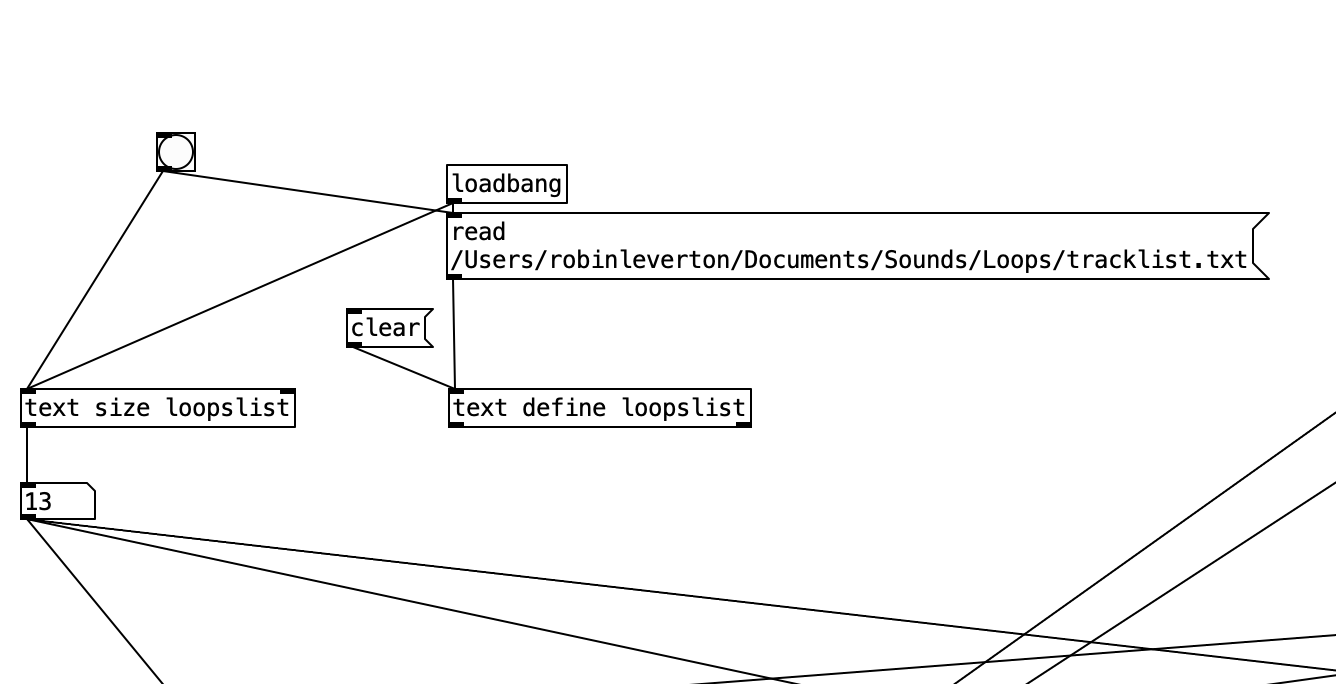
Then are the loop-loaders. These take a txt file of the paths to each loop, compile them into a list available to be called. There are 3 of these for music, voice samples, and ambience.
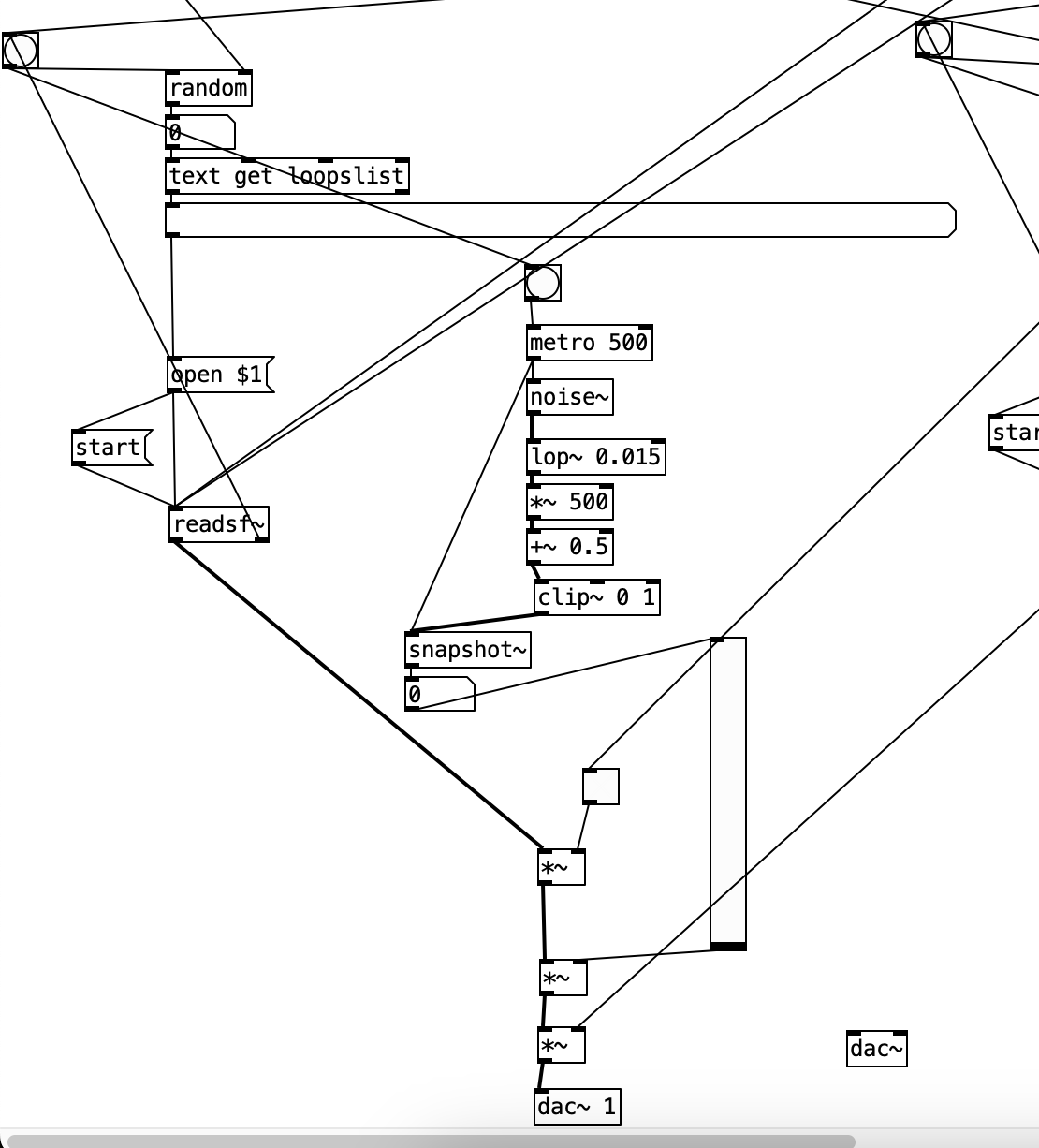
Finally, there are 9 of these sampler sequences, each outputting to a different DAC channel corresponding to a transducer in the antenna. This picks a random sample from its category list, plays it, and when finished picks a new one. Whilst this is going one, a noise value is generated to relatively smoothly and unpredictably increase and decrease the channel’s volume allowing different samples to flow in and out of each other creating a much more organic feeling effect of urban sound.
The final result went up fairly easily, we hung the piece from the ceiling above a fireplace and it loomed over the audience as intended. It did have the feel of a PA system. I’d say that given the issues that cropped up in making it, I was satisfied with the result, however it was maybe not quite where I ideally wanted it to be in its execution.
The other dominant side of my practice for the past few years has been the depiction of my body as translated through AI systems. I have tried many image-to-3D models as they have come out, Hunyuan2, TripoSR, Meshy, and most recently Trellis2. The different models do well on different things and give interesting divergence in the results that they come out with.
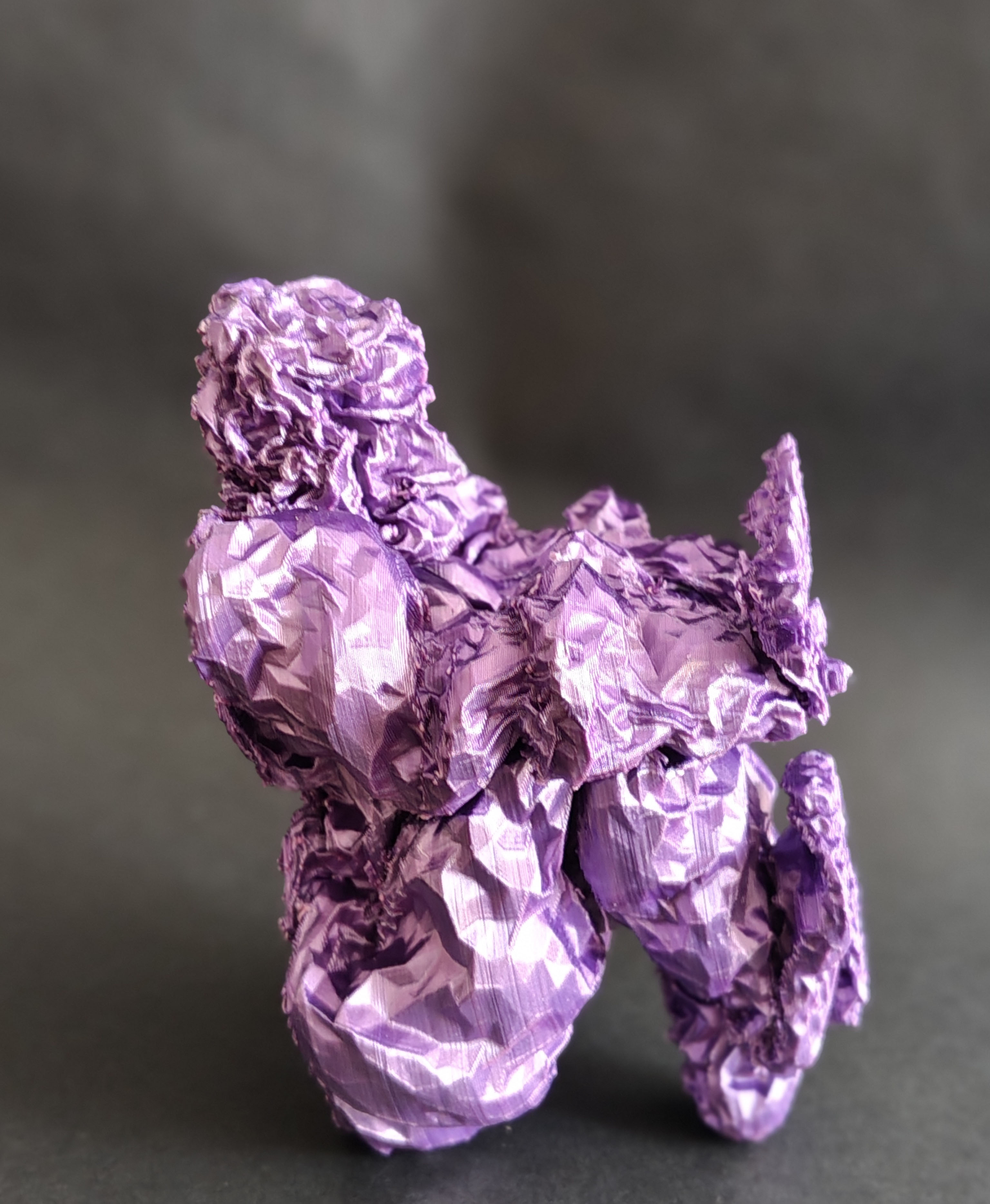
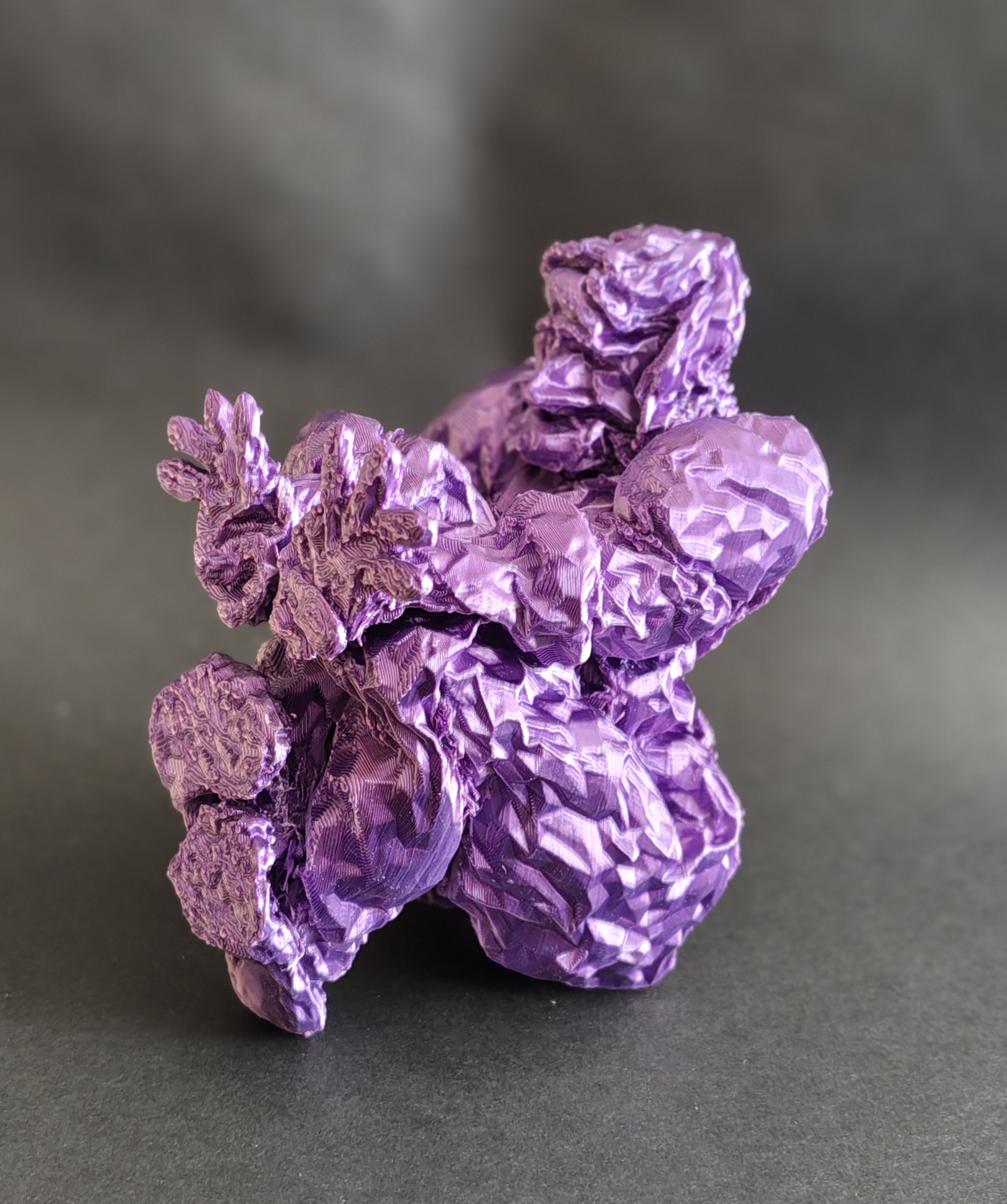
I have previously used the meshes created this way for sculptures in my A Man is A… series. However, one of the features of these types of constructions is the sometimes alien misunderstandings of the body that are created. So, I began printing out a few of these as maquettes. There is something here, but I’m not fully sure what, though I do think I might try and produce some larger versions of these figures.
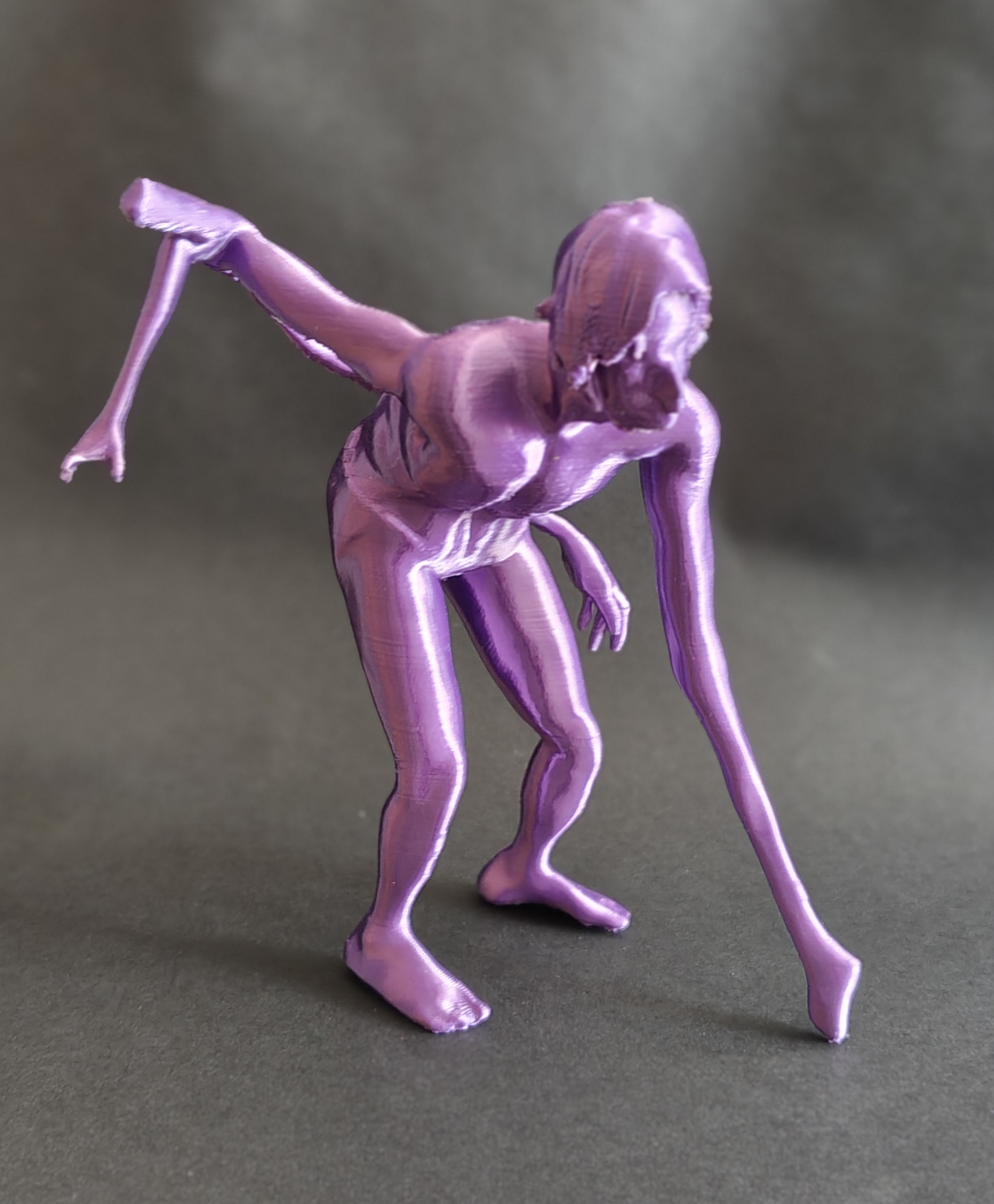
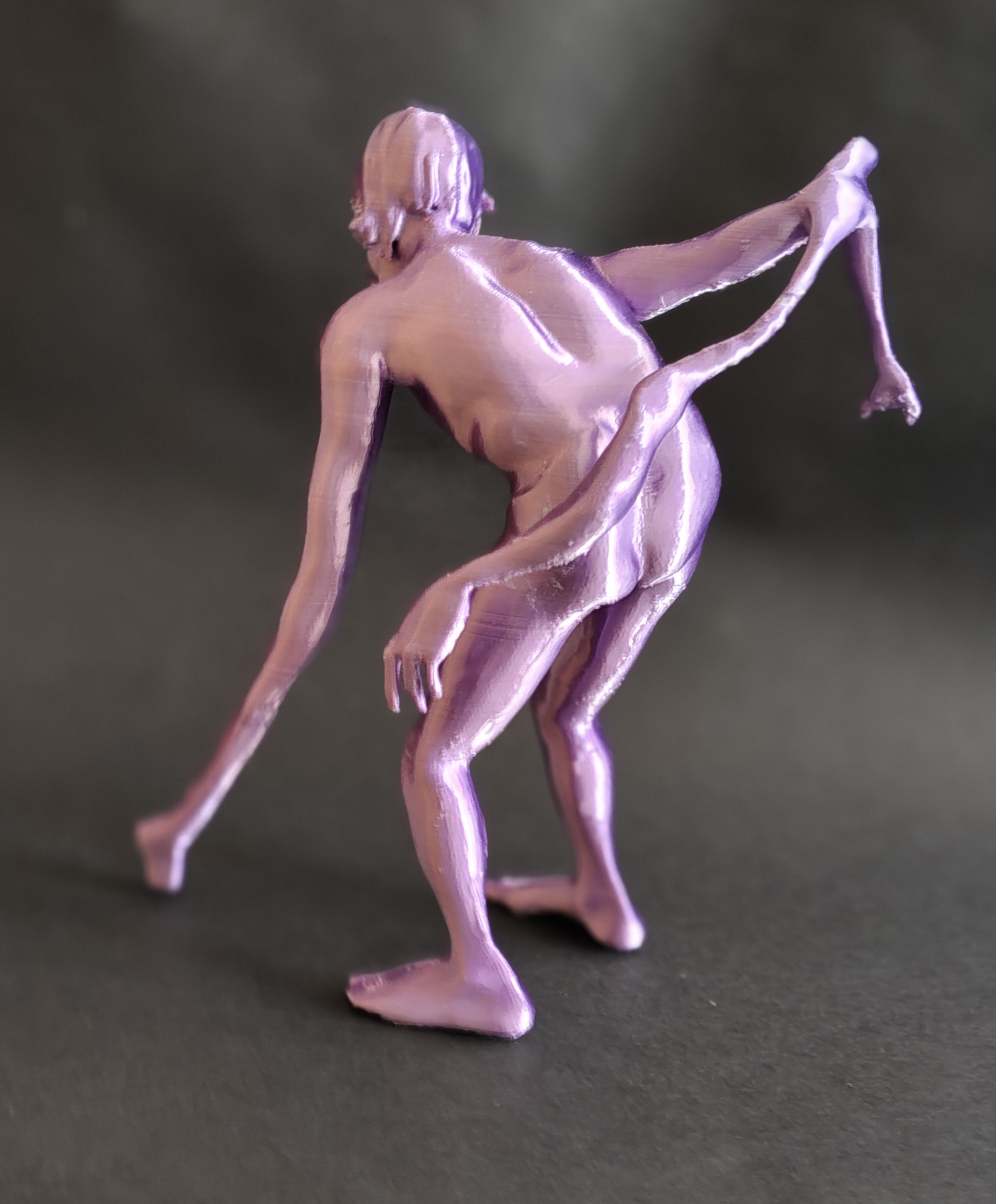
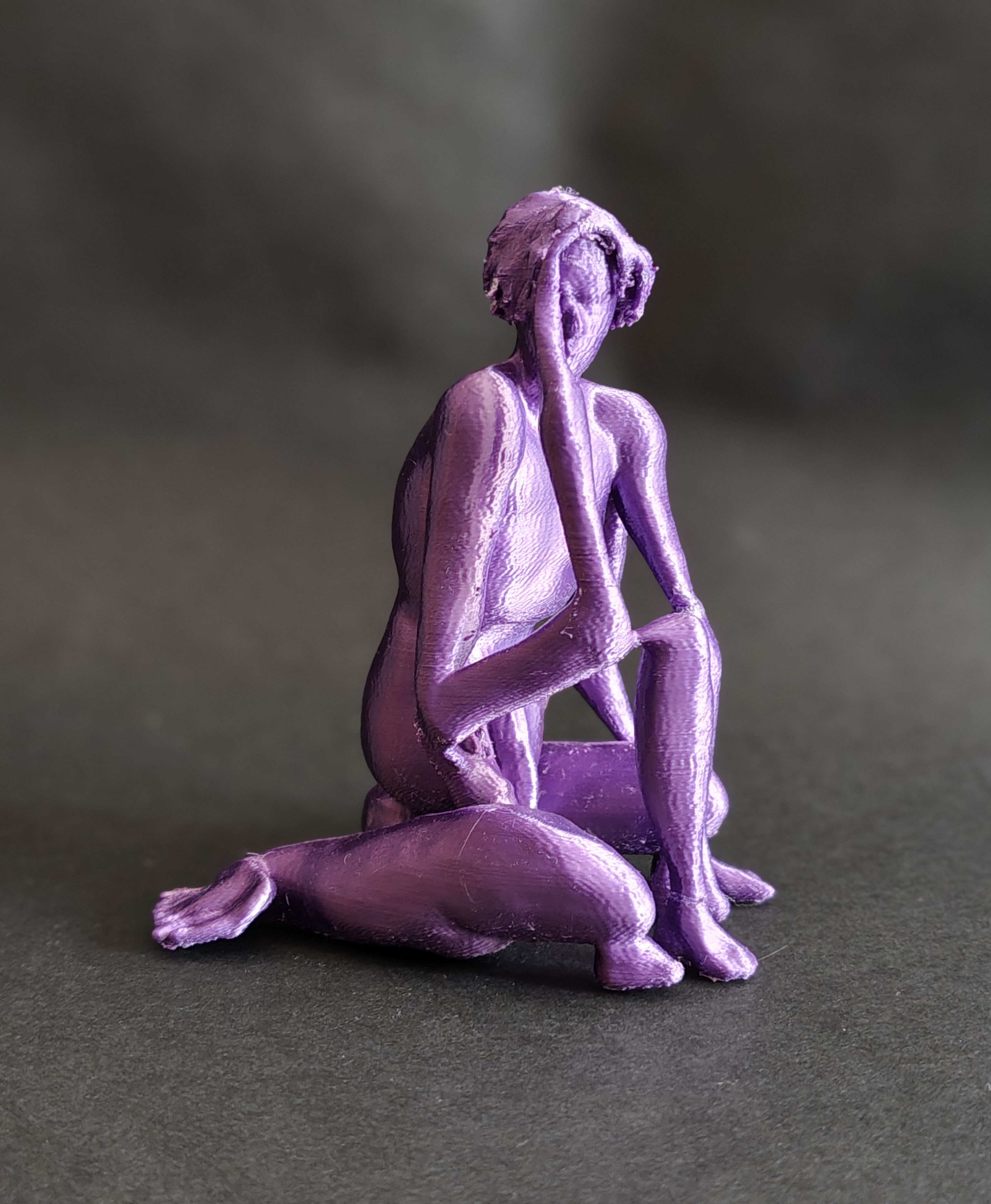
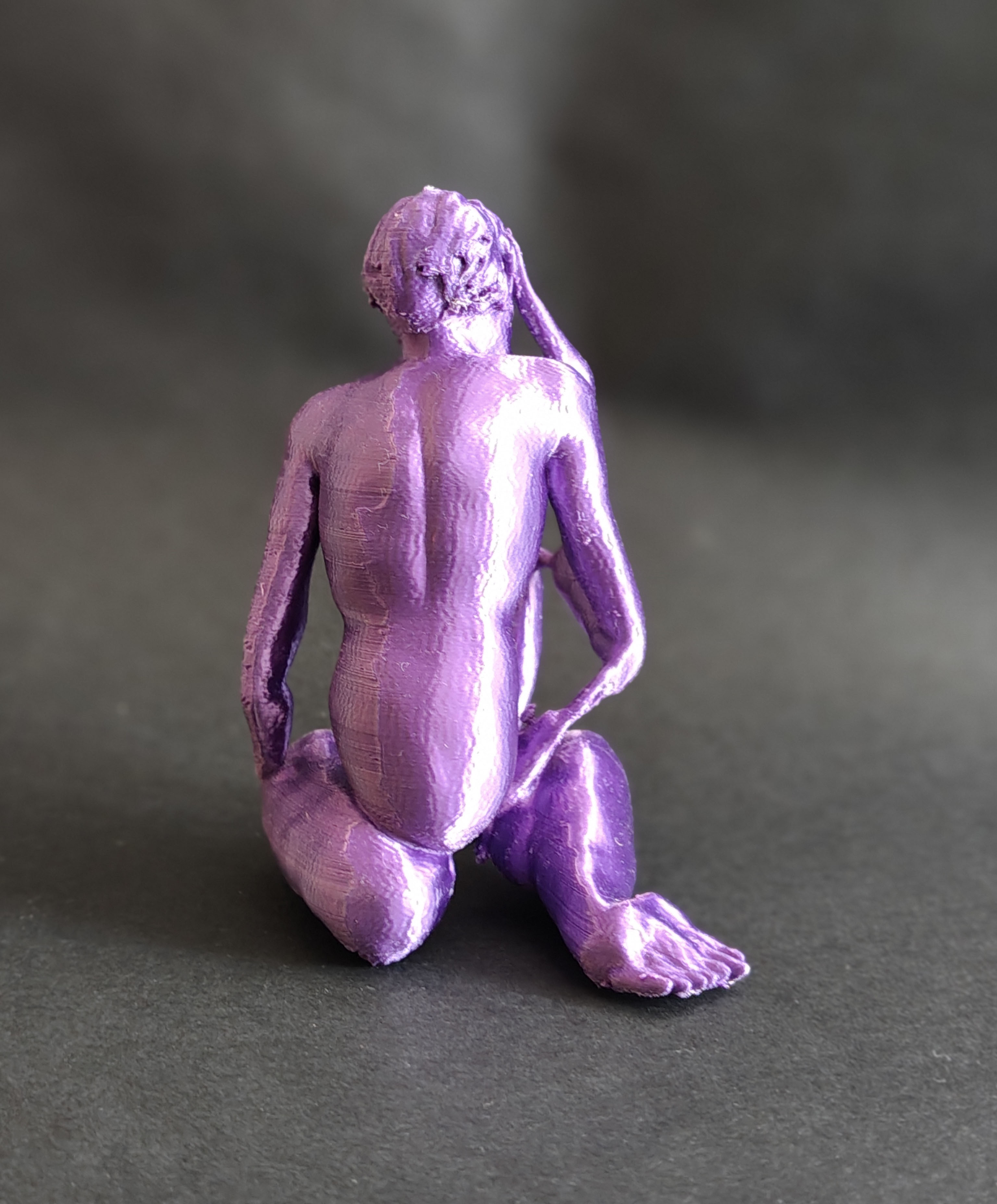
I also had a go at an idea of blowing myself up… like a balloon. Experimenting with some simulation in Blender, I came up with this figure, confined in a space but expanding. It’s not perfect by any means, and more is needed to explore here, but again as a maquette looking at creating little model gremlins for me to explore further in future.
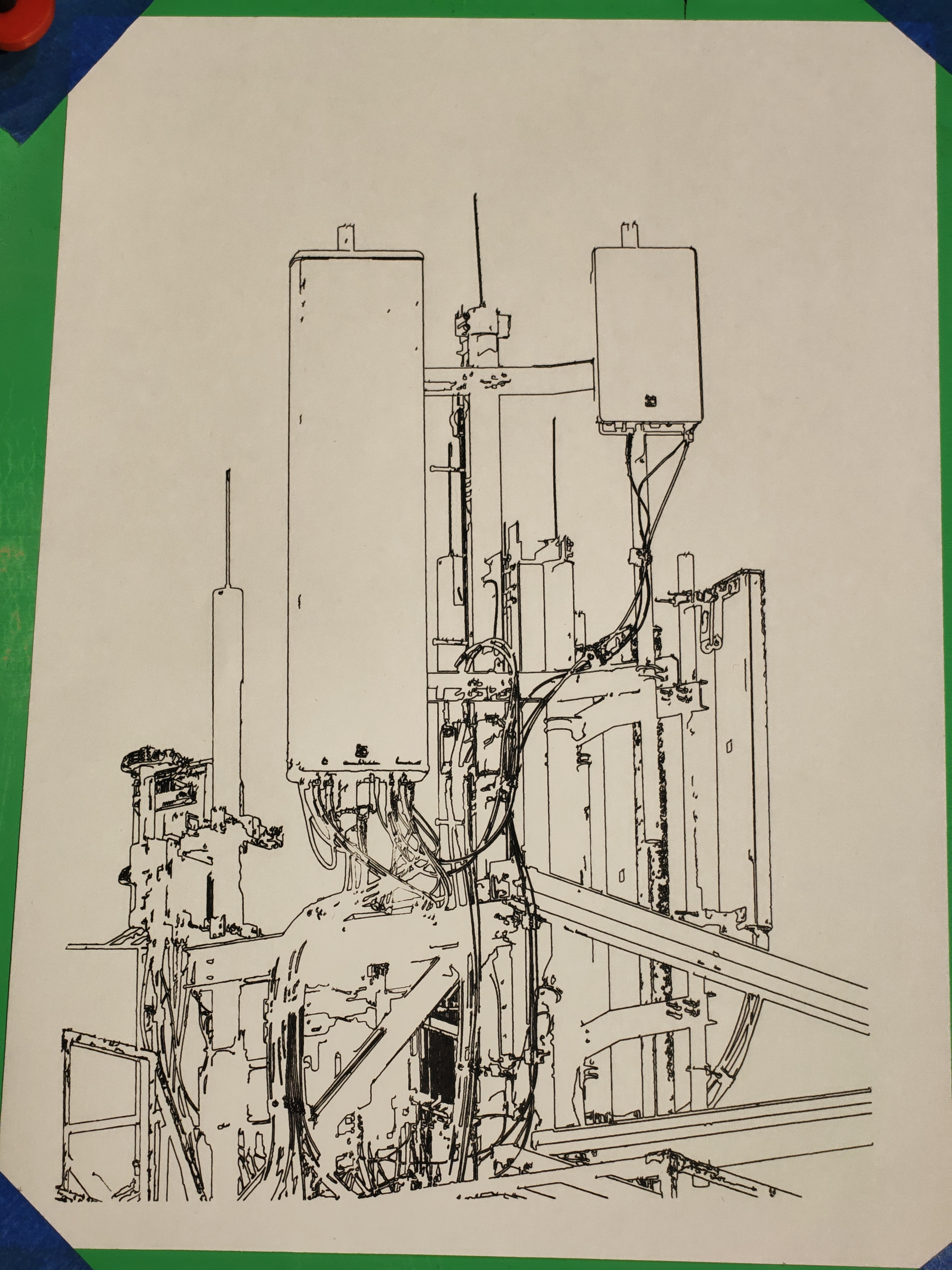
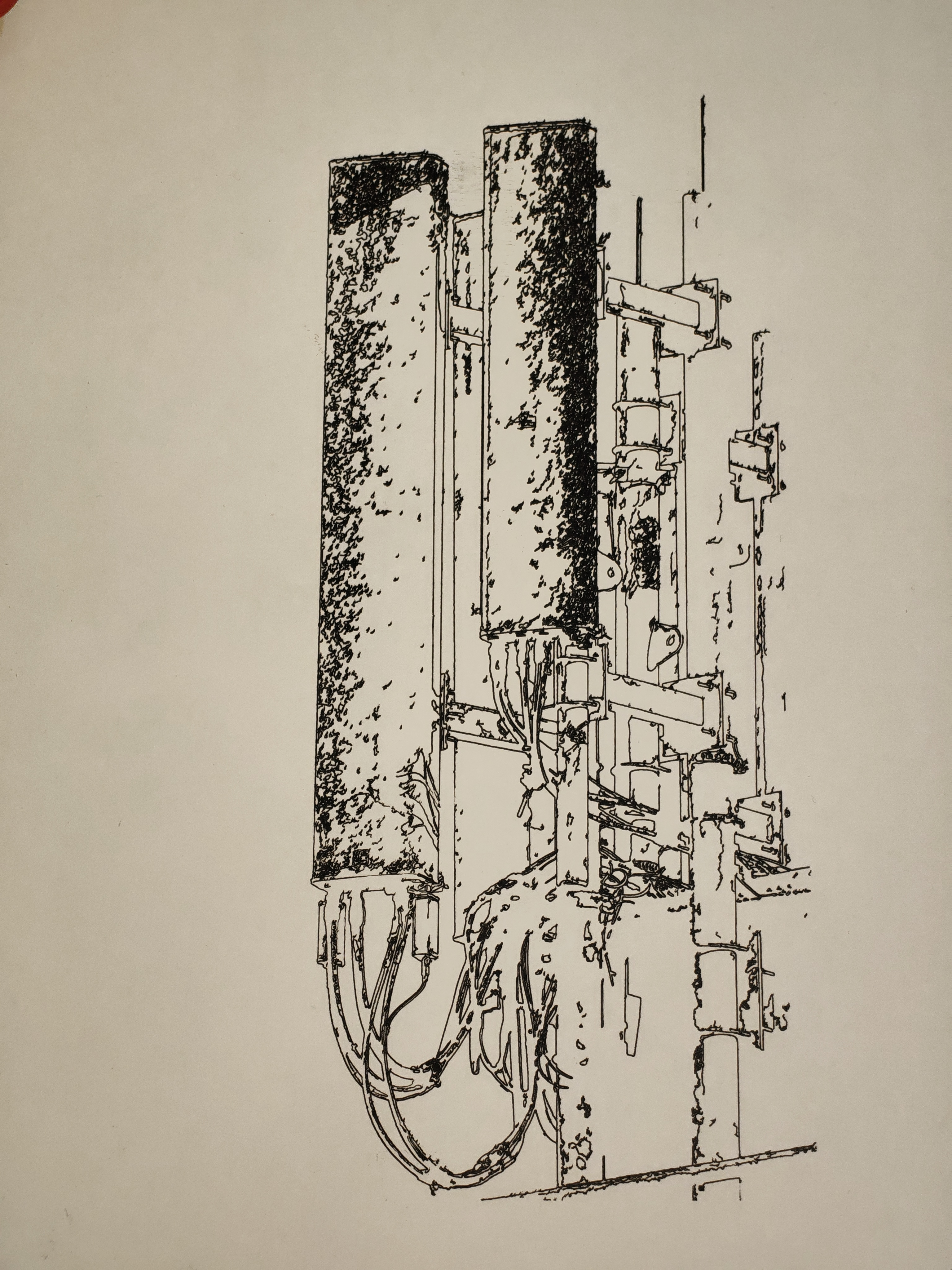
In the spirit of reviving older projects, this brought me to looking again at my drawing machine, which had been slowly degrading in the spare bedroom, some parts broken from moving a few times. After 3D printing some new parts, I gave it a few tests, including doing some drawings of antennas I have photographed out in the wild.
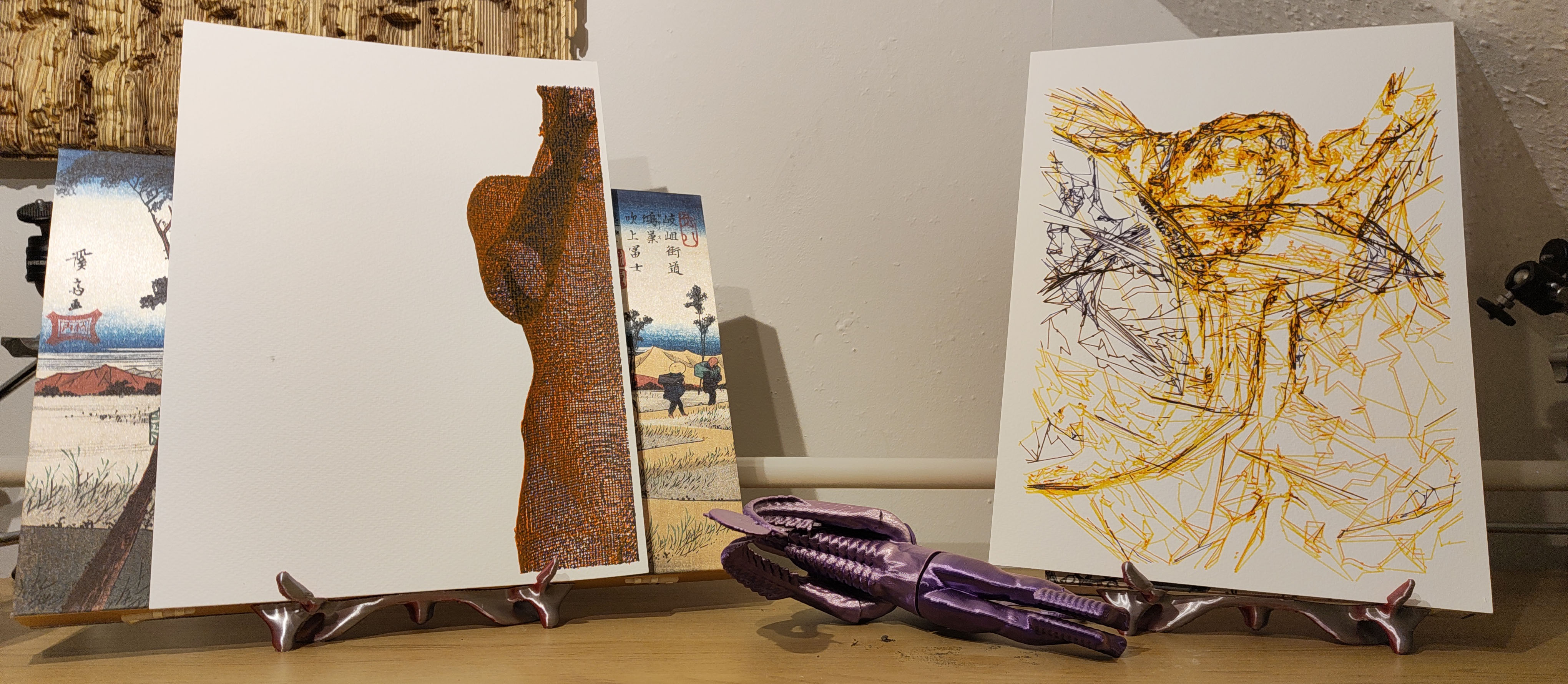
I began thinking about how I could use this to depict the computationalised human form from my 3D mesh experiments, and what this depiction of the body can do when flattened in this plane. I used the Freestyle SVG exporter to take renders of my meshes from angles that imposed an ambiguity on the subject and output their wireframes to SVG files that my plotter could read.
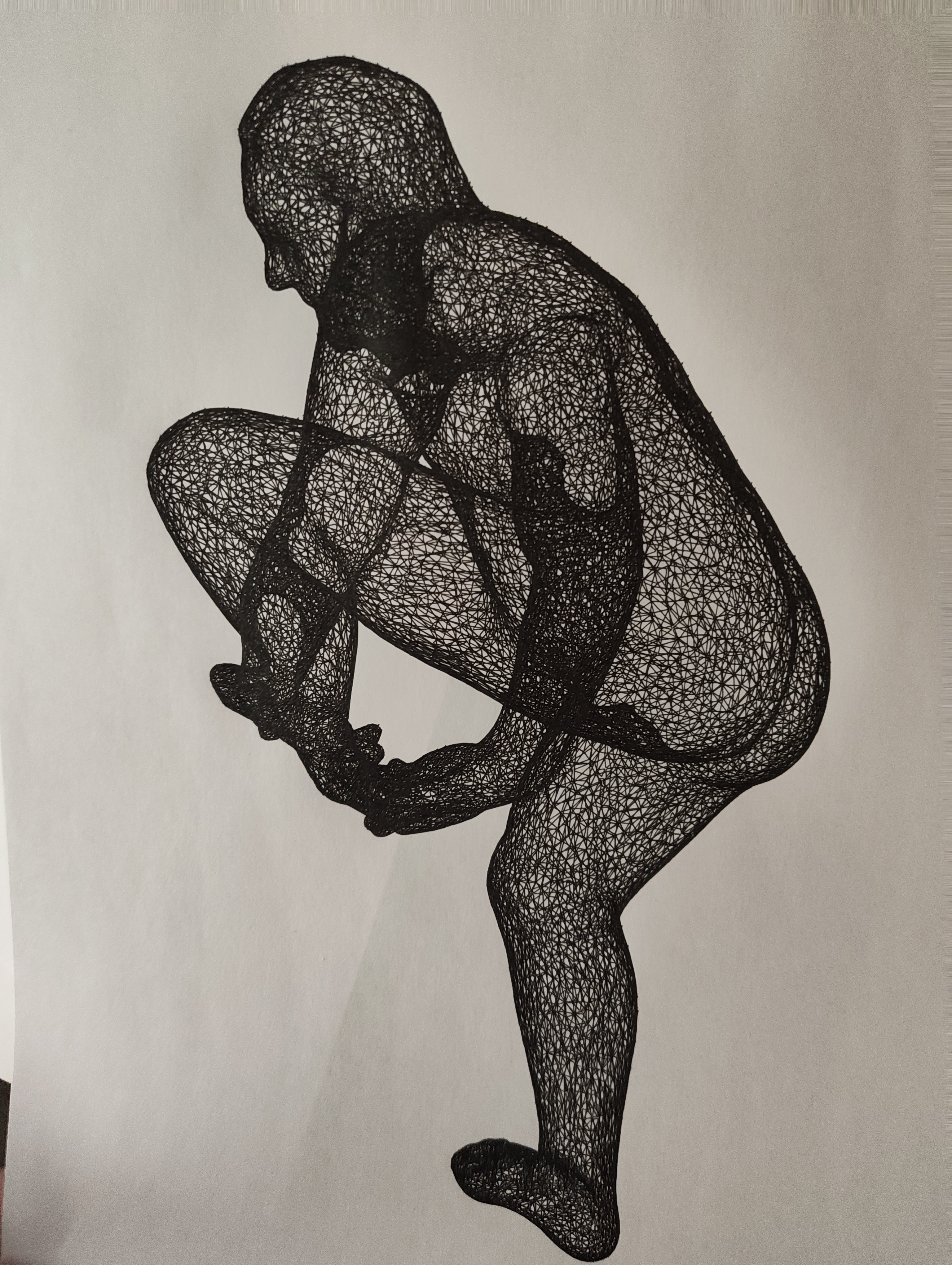
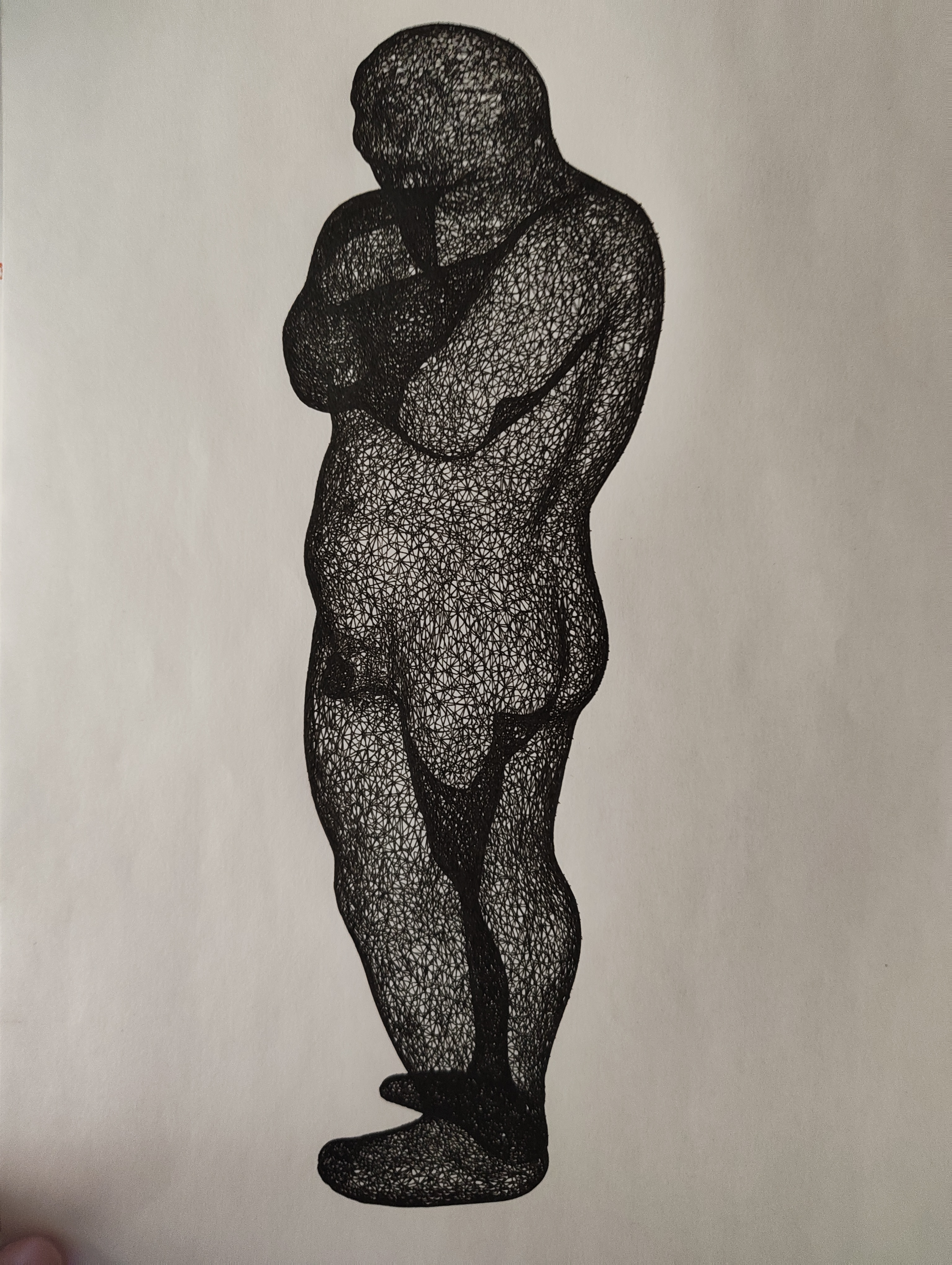
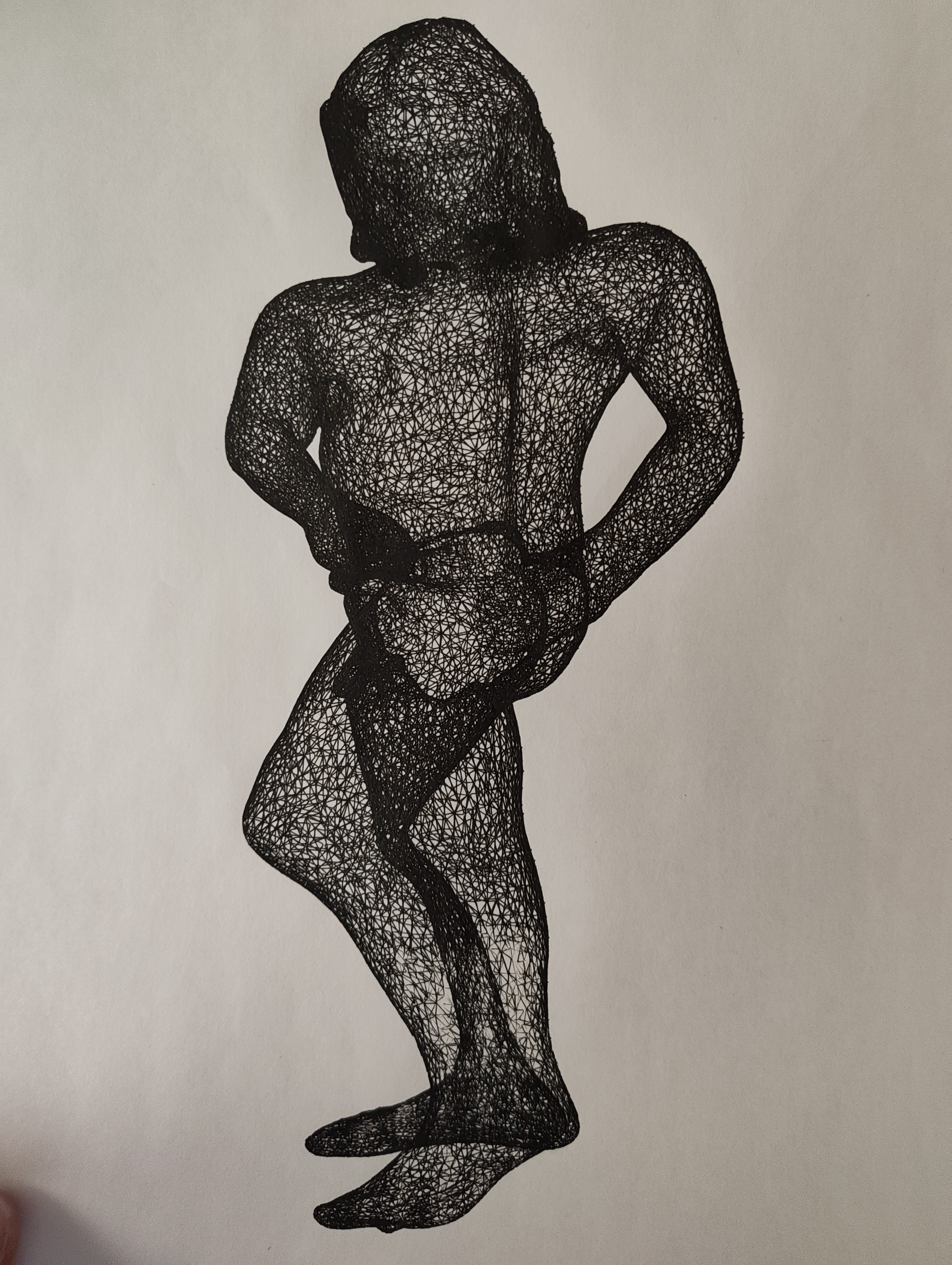
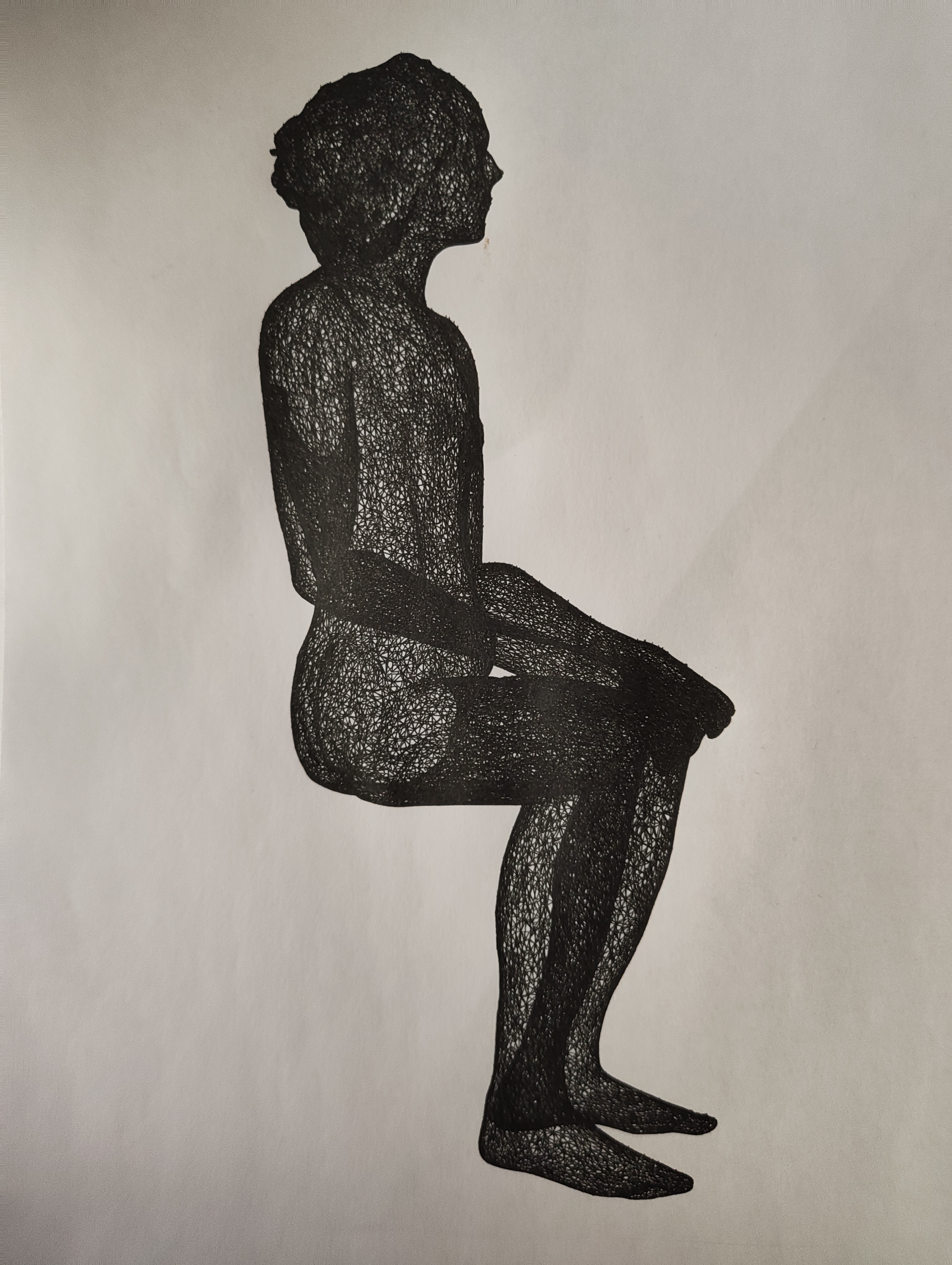
The illusory lack of directionality of these images is very fun, as well as the way the body overlapping itself is part of this reconstruction of form, loosened even more by some of the mis-understandings of the AI. My shoulders aren’t that broad, my beard is a feature of confusion especially for the AI.
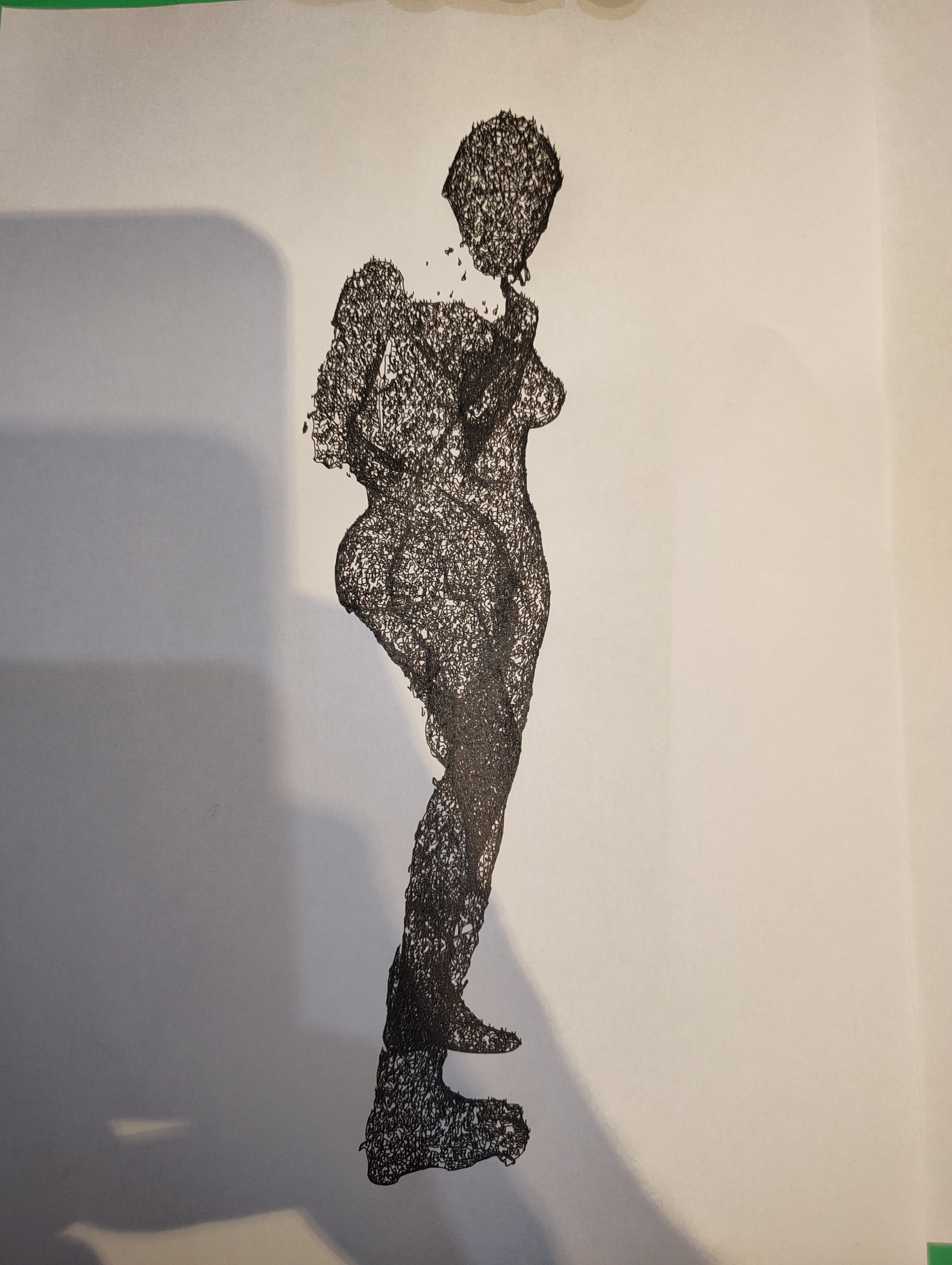
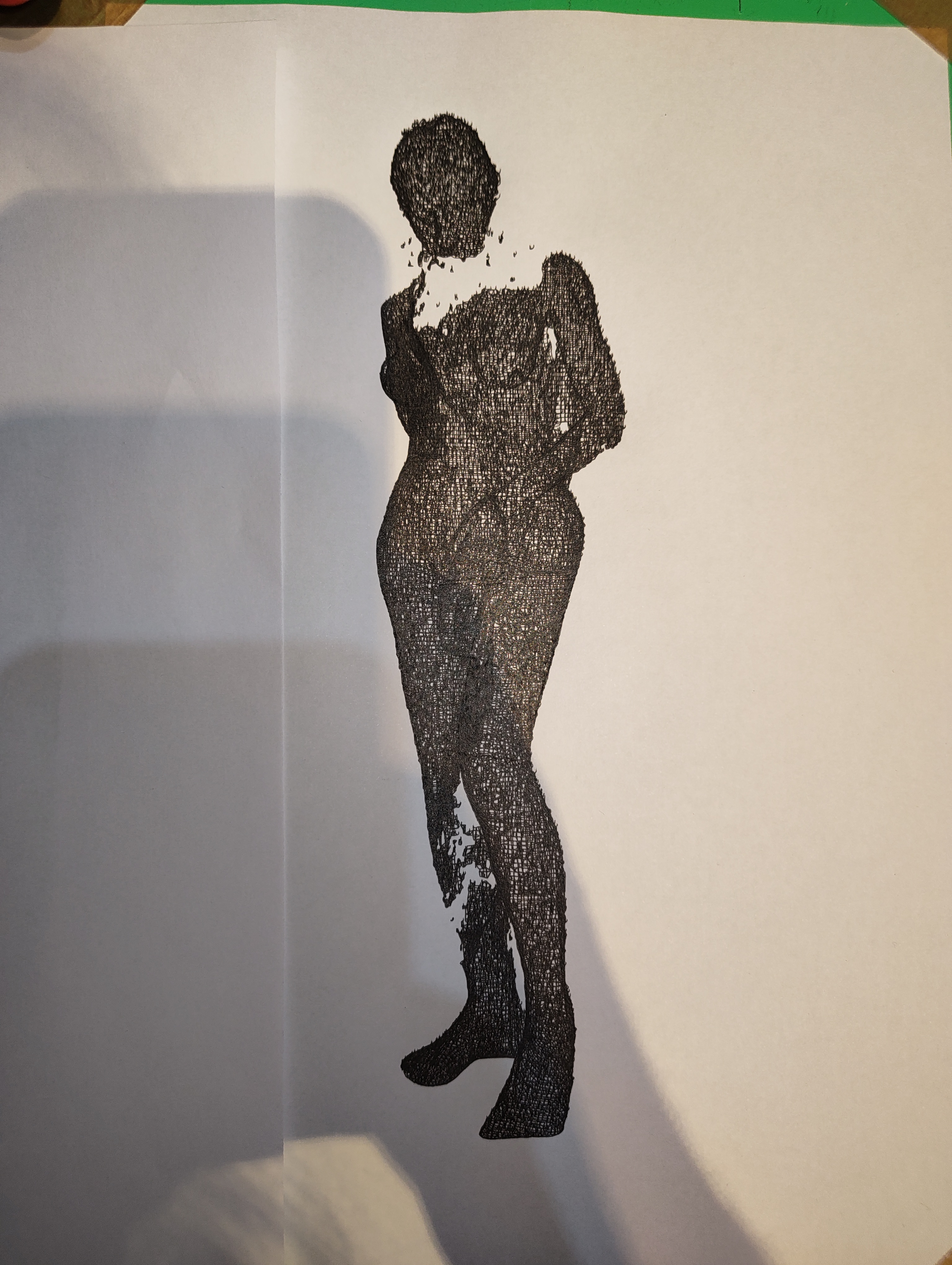
And I used this more with the above studies. Sometimes the AI will gender me, or rather, it is always gendering me, I notice it with some outputs it makes me more ‘masculine’ broader shoulders, better abs etc, but sometimes, perhaps because of the pose or my longer hair at the time, it would see me as female, and add breast matter, smooth out the groin, slim the waist etc. So I began trying to generate feminised images of myself using stable diffusion, and then feed these into the 3D pipeline. These two show a model that the 3D just couldn’t handle the beard and the body hair – these are not feminine it seems, so they become these dissolved moments in the mesh. I think what is occurring in the latent space is a recognition of a gender to the image, and then that is reinforcing / being worked towards by the mesh generator, which produces something I wouldn’t say is in between, but more alien for sure. This I want to explore further.
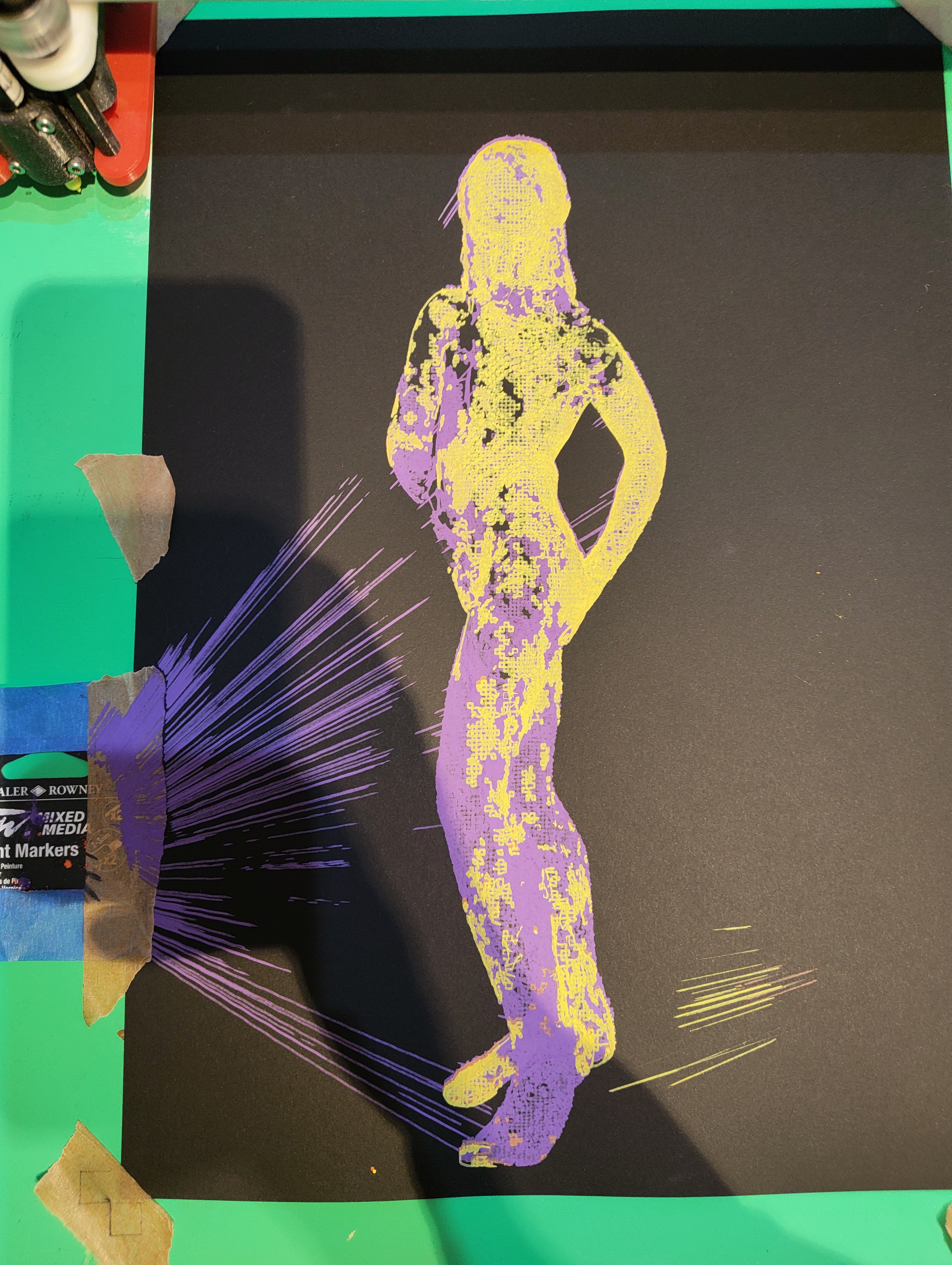
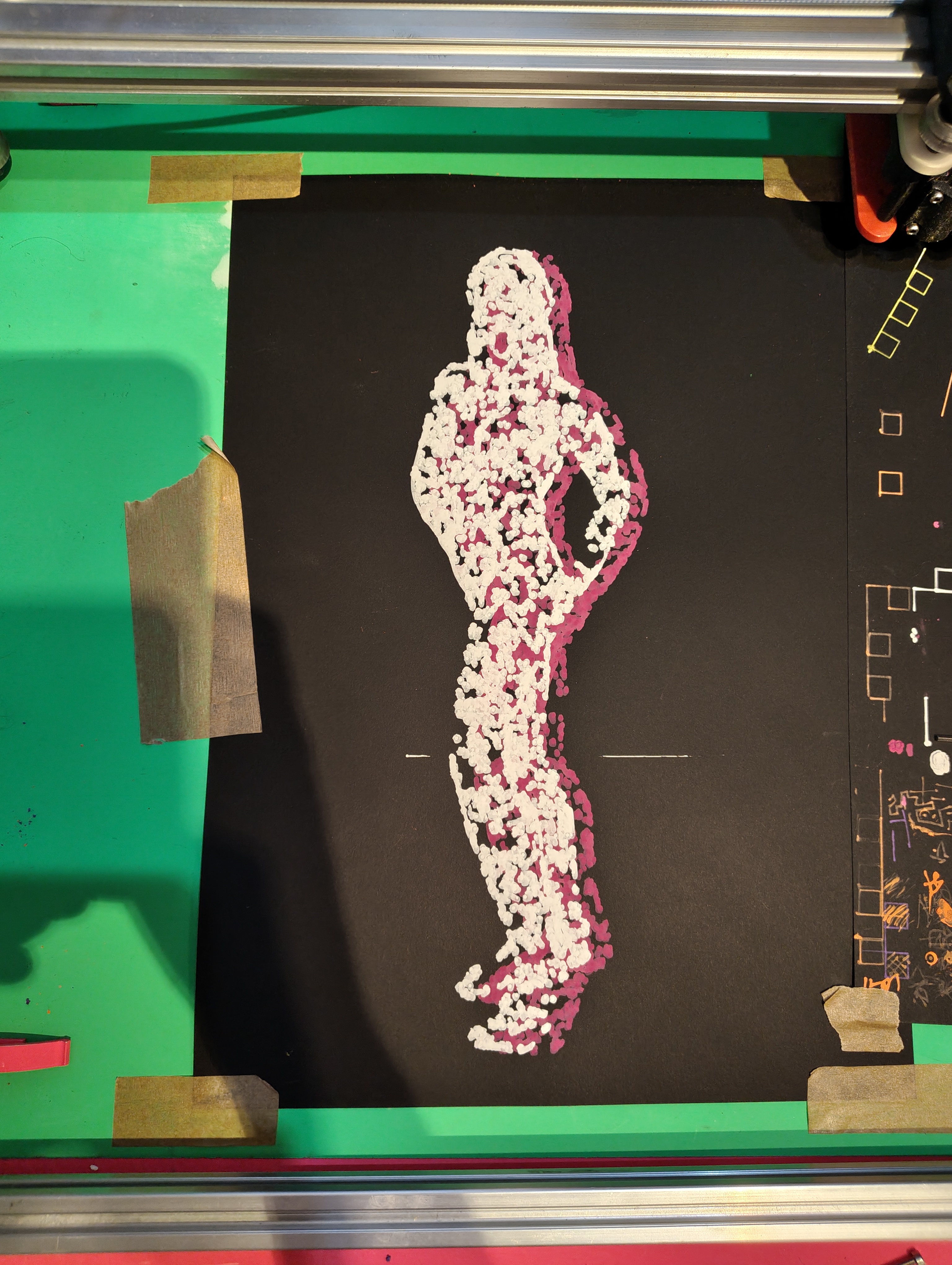
I began playing with layering colours based on occlusion of the render in blender. It’s definitely tending towards some more painterly outcomes and providing interesting views in the solidity of the models.
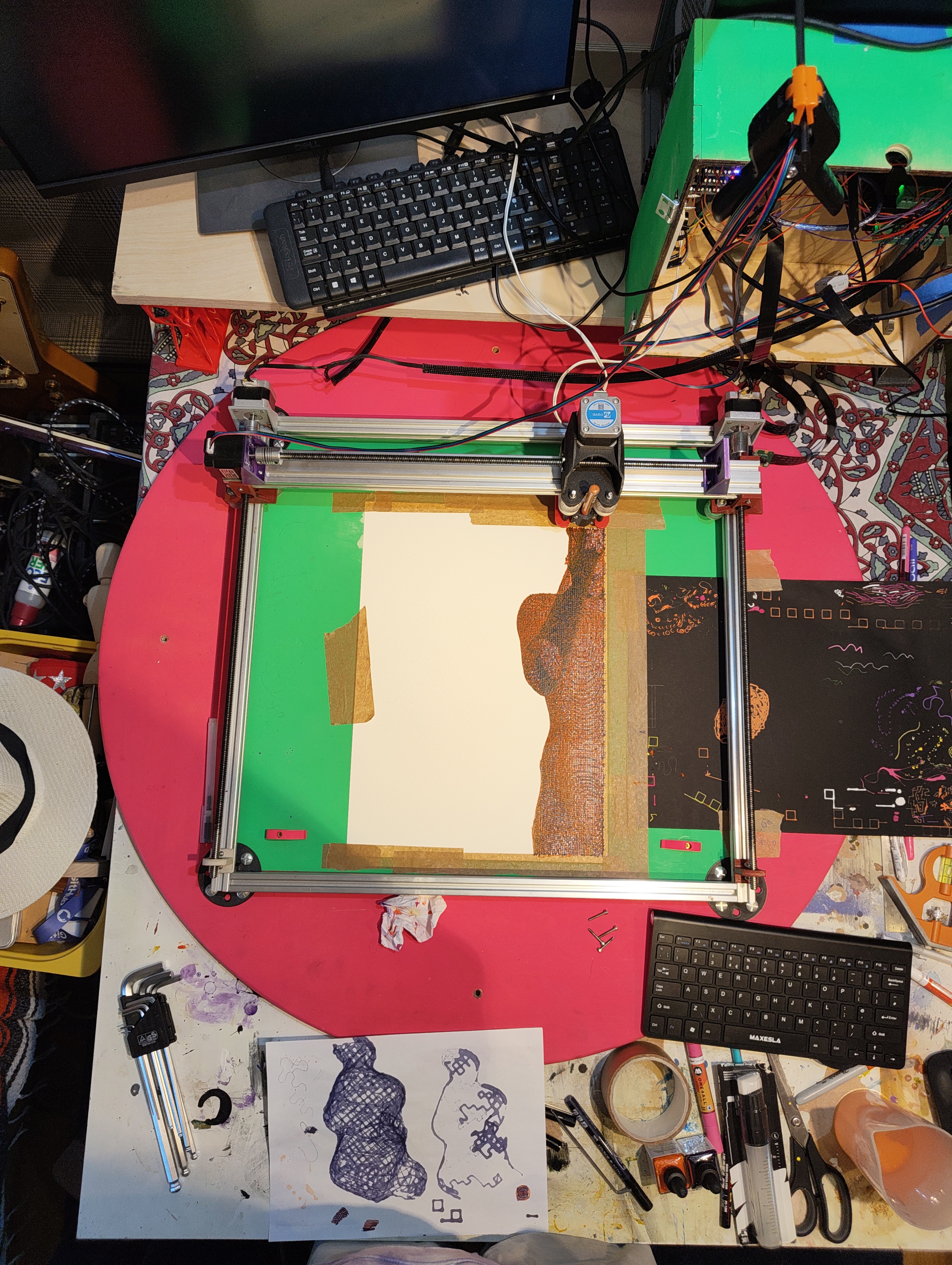
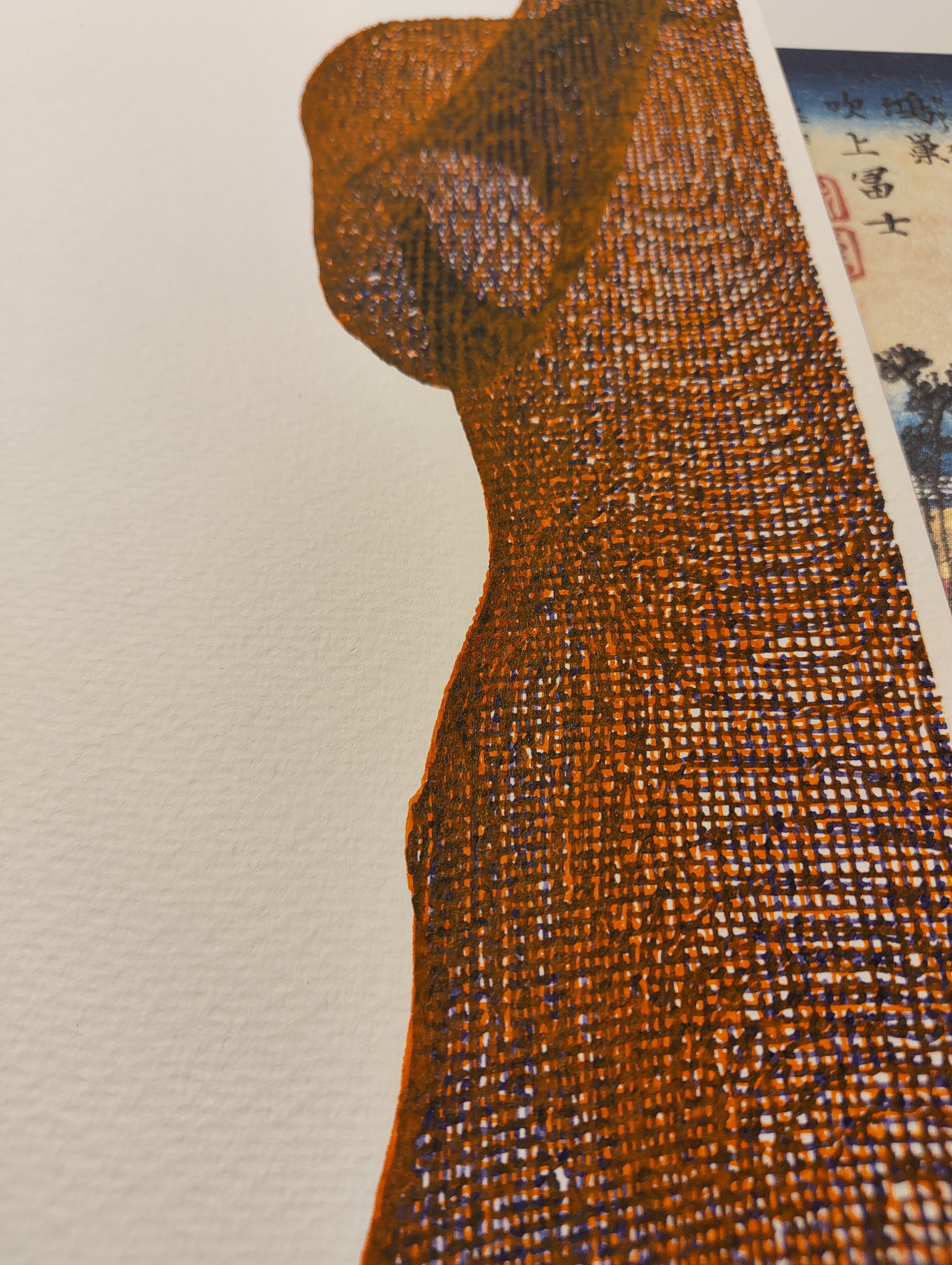
For these two outcomes I wanted to begin playing with framing, trying to find ways to look at the body in a more discontinuous way, breaking up its completeness, taking the subjecthood away, turning the body into an abstract set of forms.
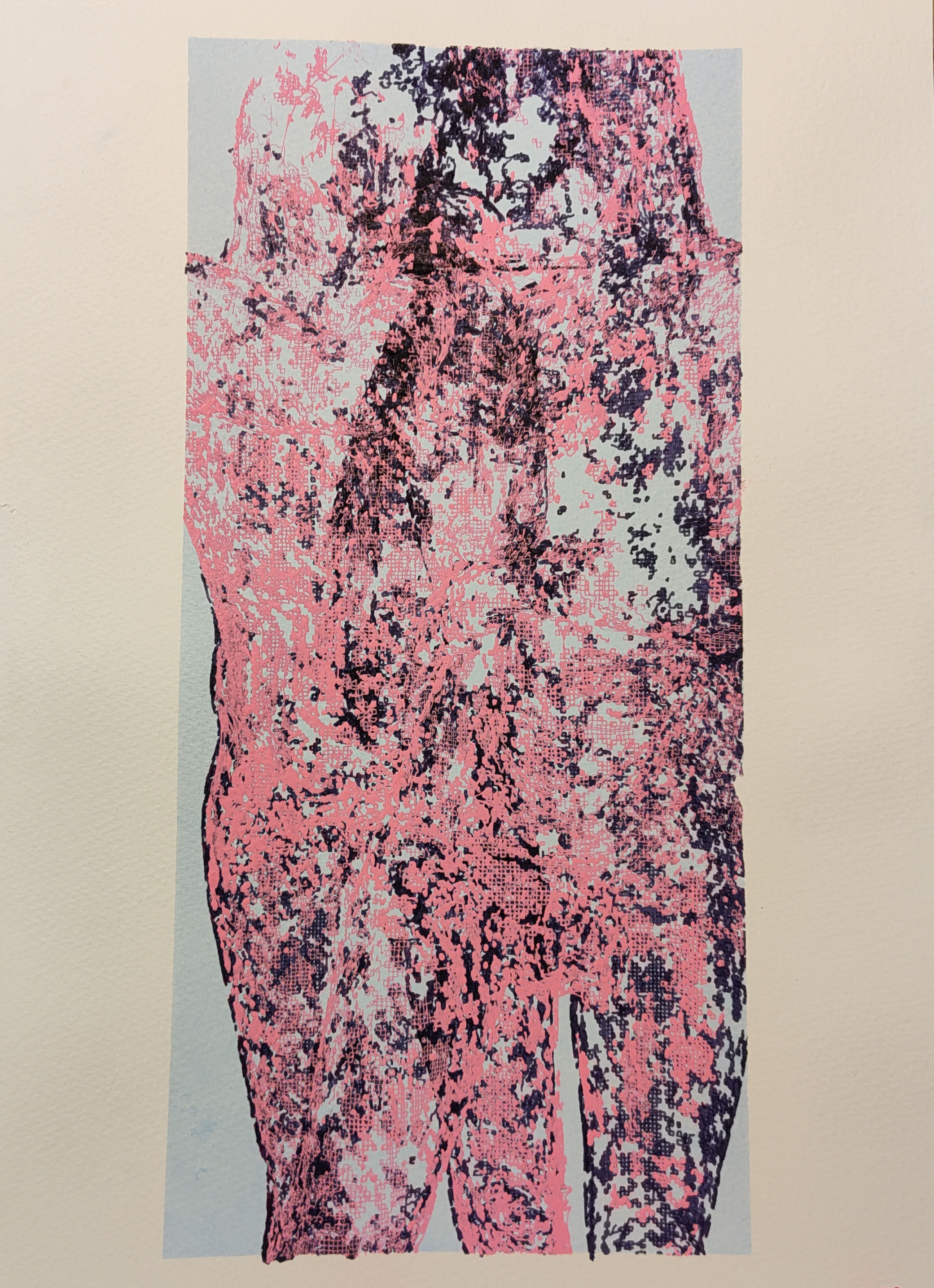
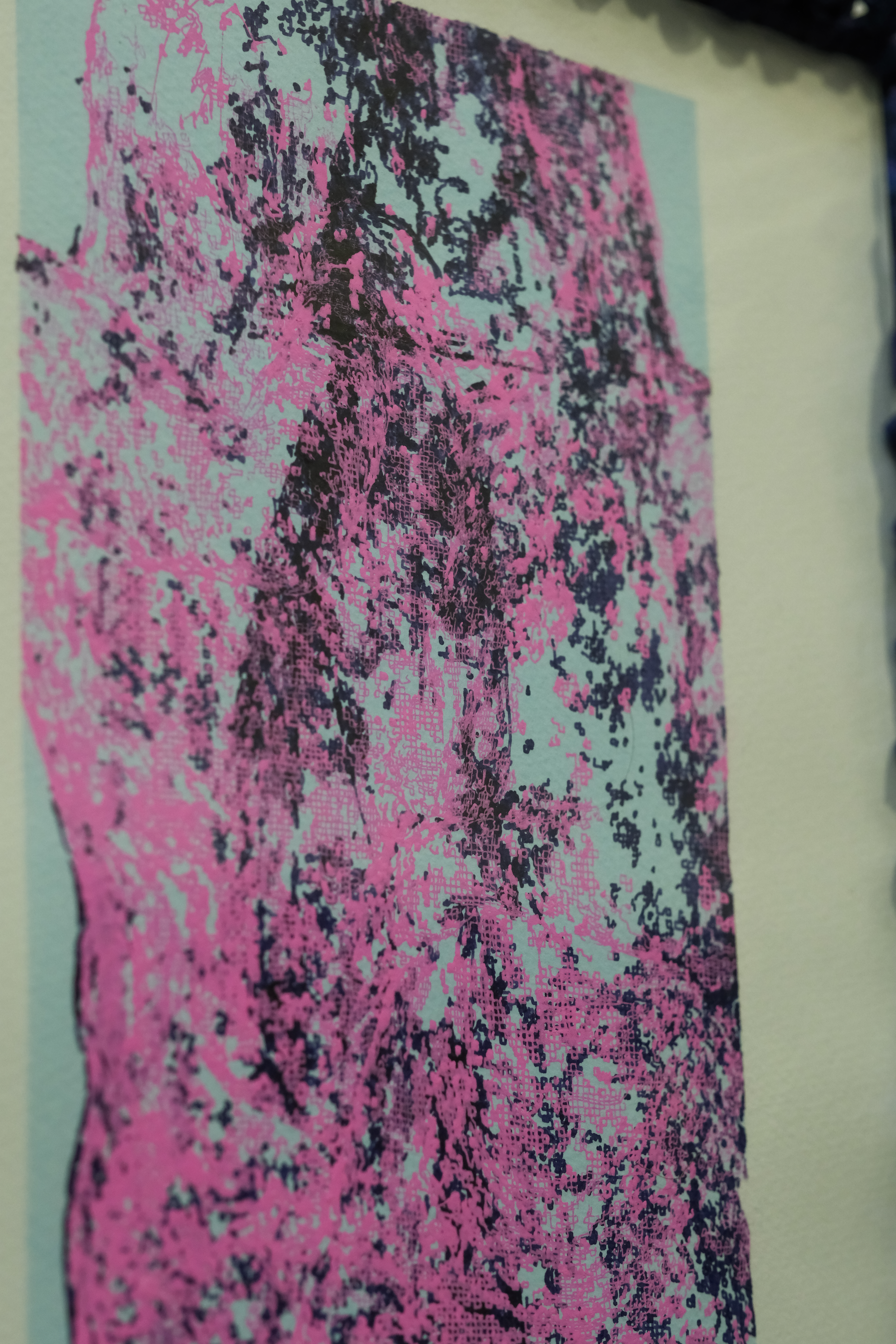
The culmination of these experiments got to this point below, a drawing of two figures in pink and purple. The bodies here were additionally incomplete as the machine “crashed” do to a slight misalignment in the vertical axis which when doing a fast travel move caused it to bind up and lose it’s position relative to the paper. As a result I had to stop the drawing early. This left an intriguing texture to the drawing, they’re dissolving almost, into each other or into the process of their own creation.
This is where my personal practice halted for a few months, I was working with my collective on a project in Portugal which I will blog about soon, and then I released a book I have been writing with my collaborator on The Apartment exhibitions, which I will also write a piece about in future.
Whilst away I also signed up to take on some shared studio space at Set Vauxhall with some friends, so I have an extra space to work in beyond my bedroom which has been fun to begin building out and getting going in.
After arriving back and launching our book, my attention was now refocused onto the Computing Staff show Manifold 3.0 at Goldsmiths, organised by the incredible Owen Planchart, one of my coworkers in the technician team.
In the original proposal, I had intended to show Synapse the cell tower speakers from earlier, however I was feeling incredibly burnt out, and instead opted to show the drawing just previously shown. I had thought it would just be that on a wall, but as the date drew nearer I started feeling that this wasn’t enough. I should pair it with one of my photographs of cell antennae. Then that still wouldn’t be enough, I’d need to frame them. I looked at cheap Ikea frames and again wasn’t satisfied with that idea until, seeing my friend Xintong’s proposal where she was 3D printing frames as part of her work, I realised I didn’t need to buy a rectangle of mdf, I could make any frame I wanted…
So at this point, the frame took over the artwork.
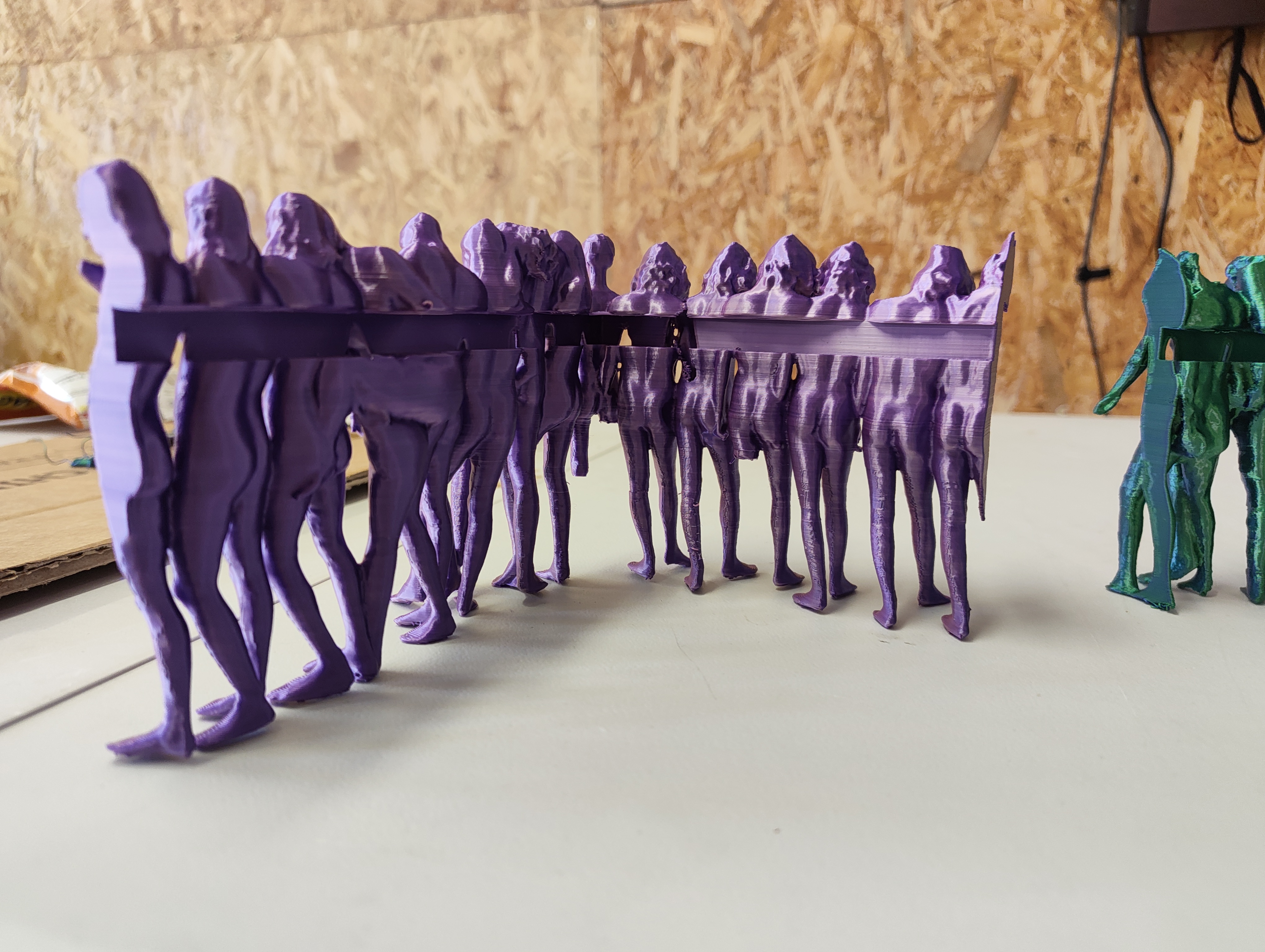
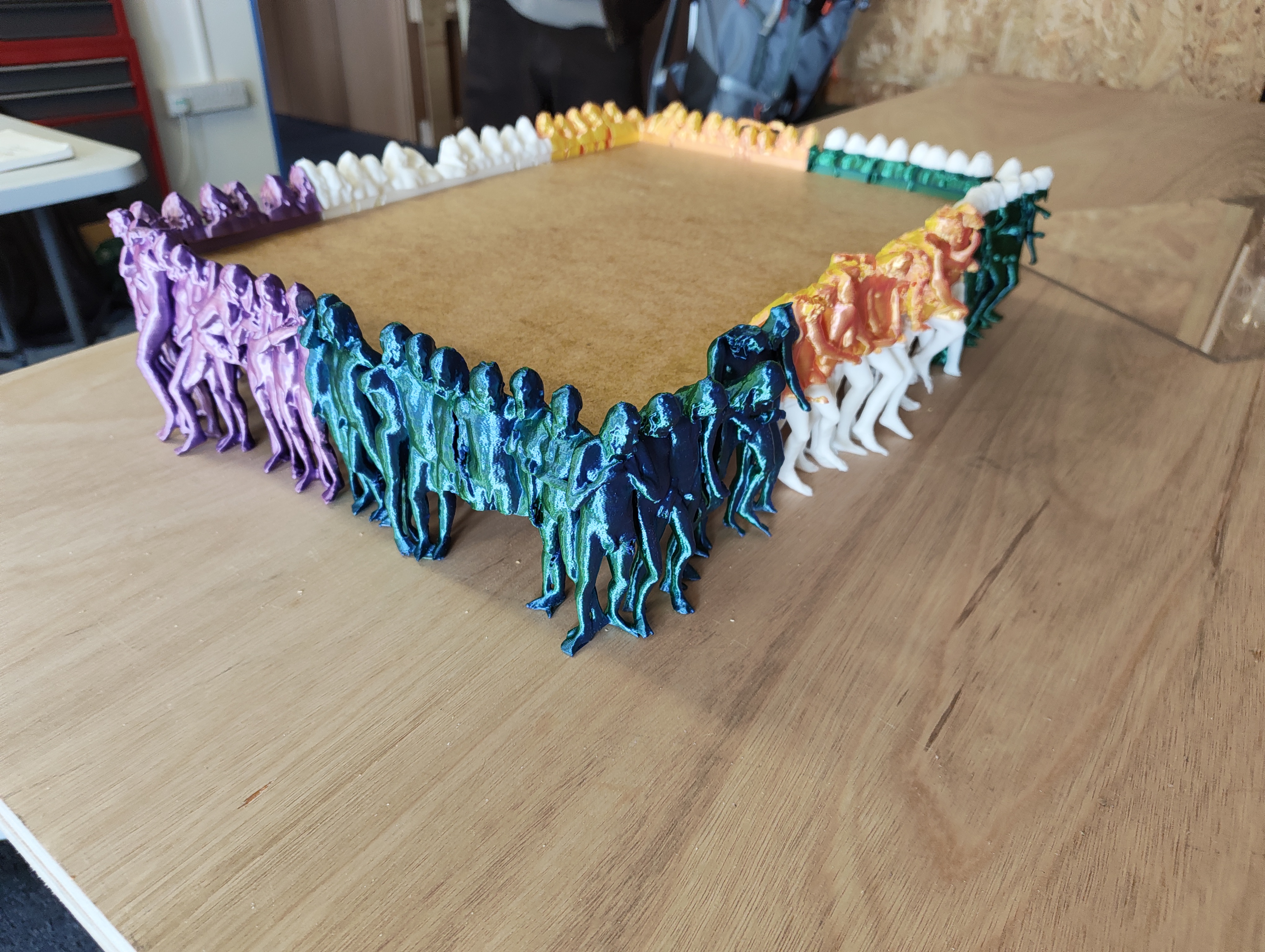
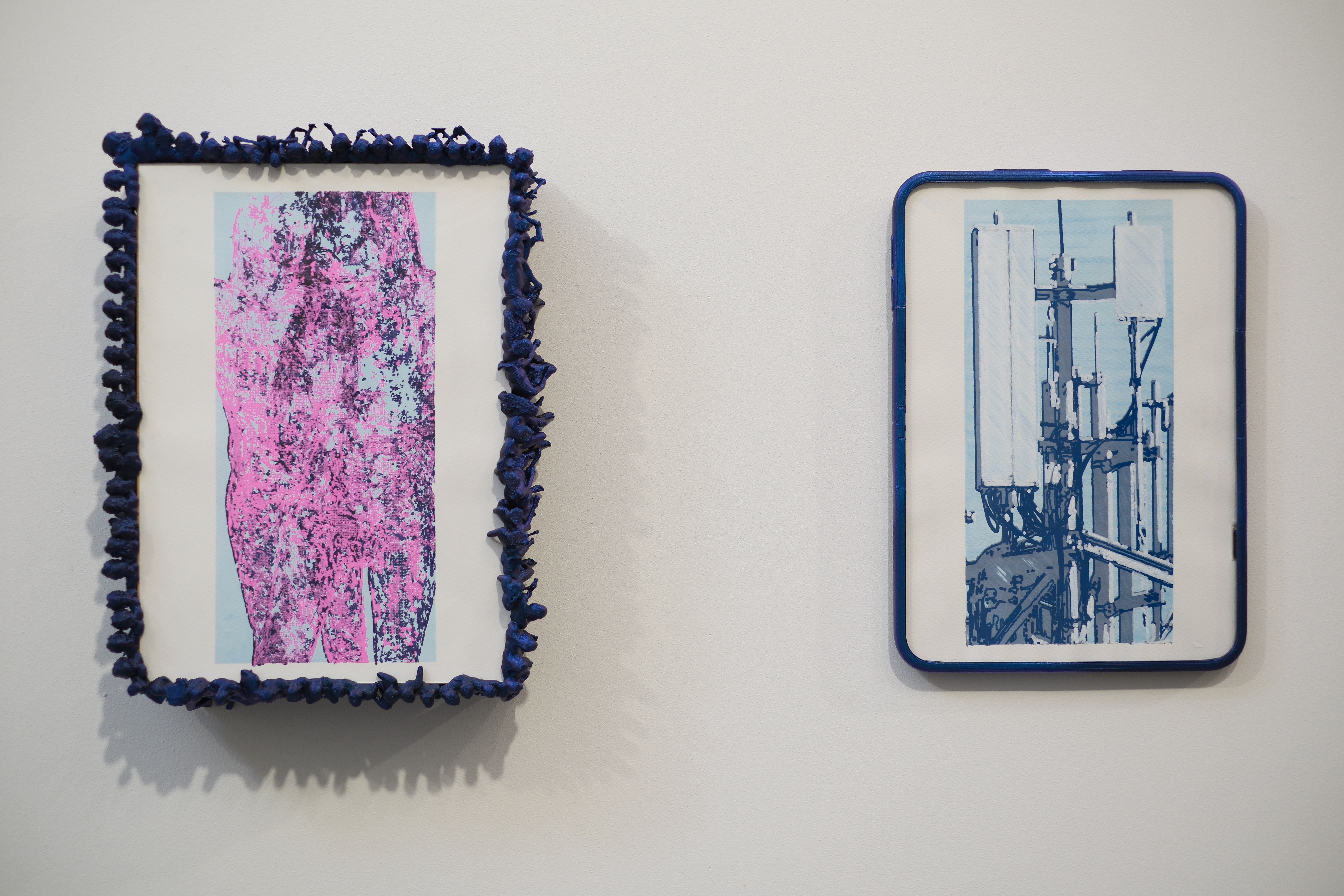
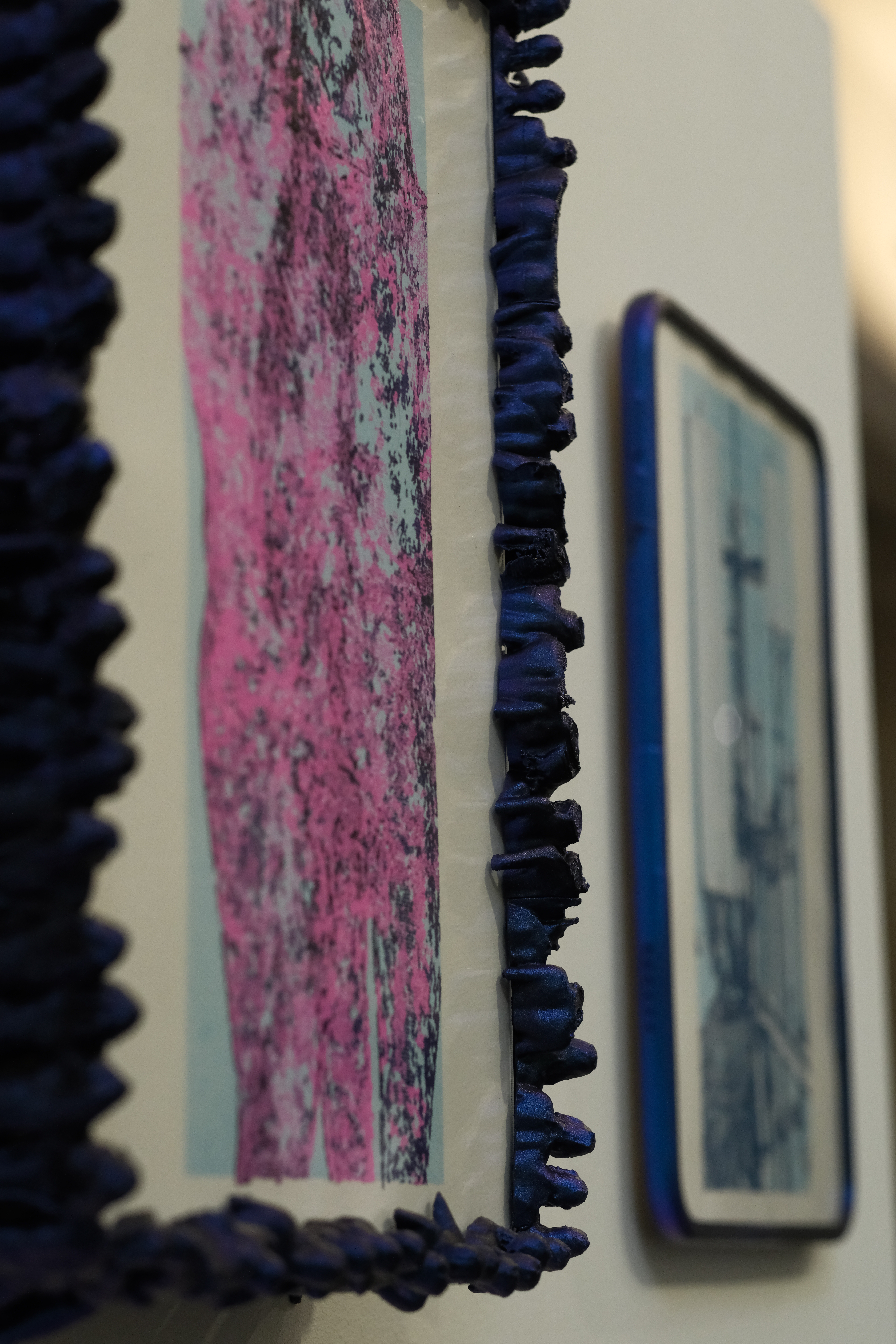
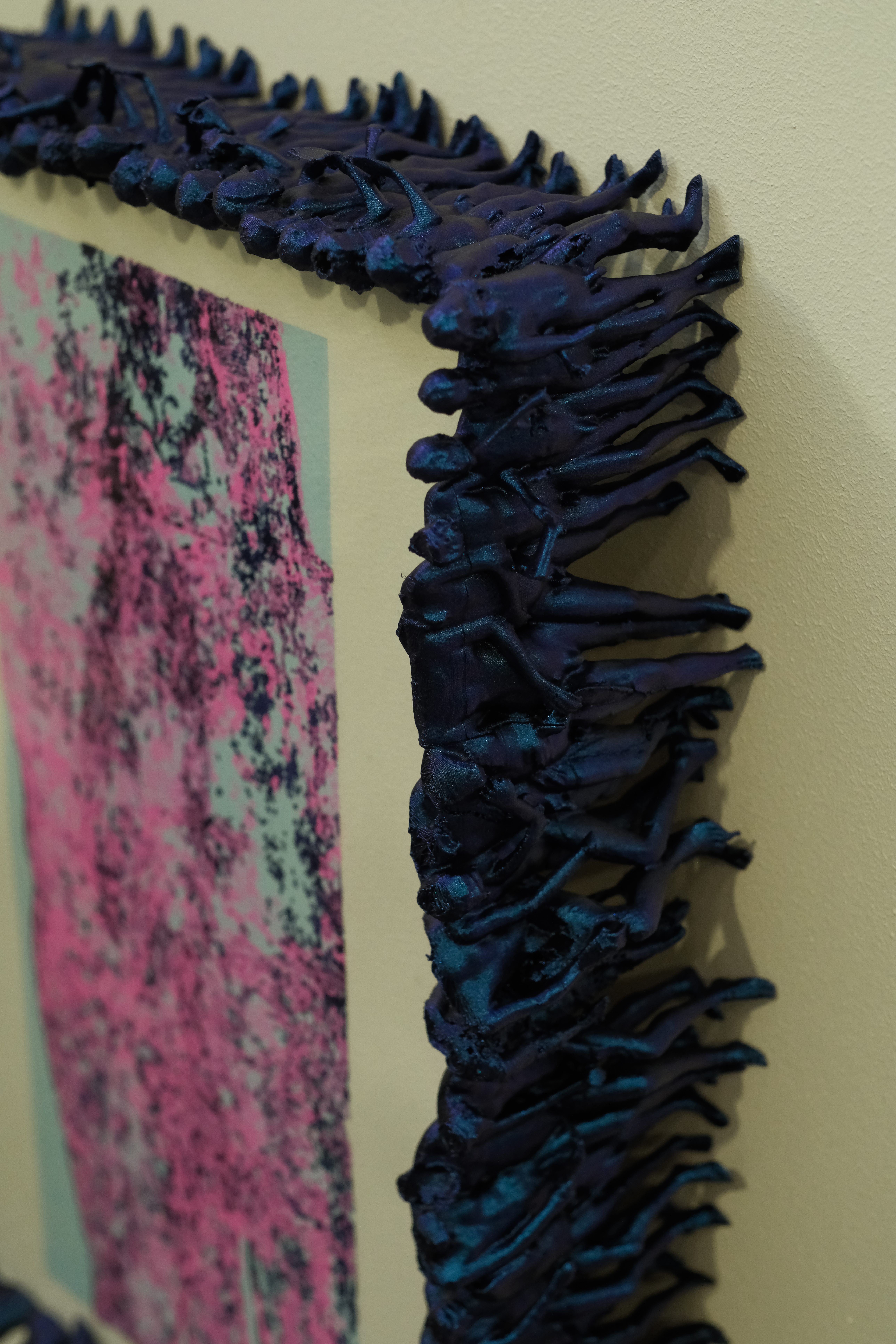
I made two frames, one for each image that I wished to display. The first was the sequence of images from which I’d begun all these drawings with, which was actually from a video of me in the shower in Portugal last year. I distributed the meshes out in blender, culled ones that didn’t fit and cut out the gap for the backing panel, drawing, and acrylic sheet to slot into.
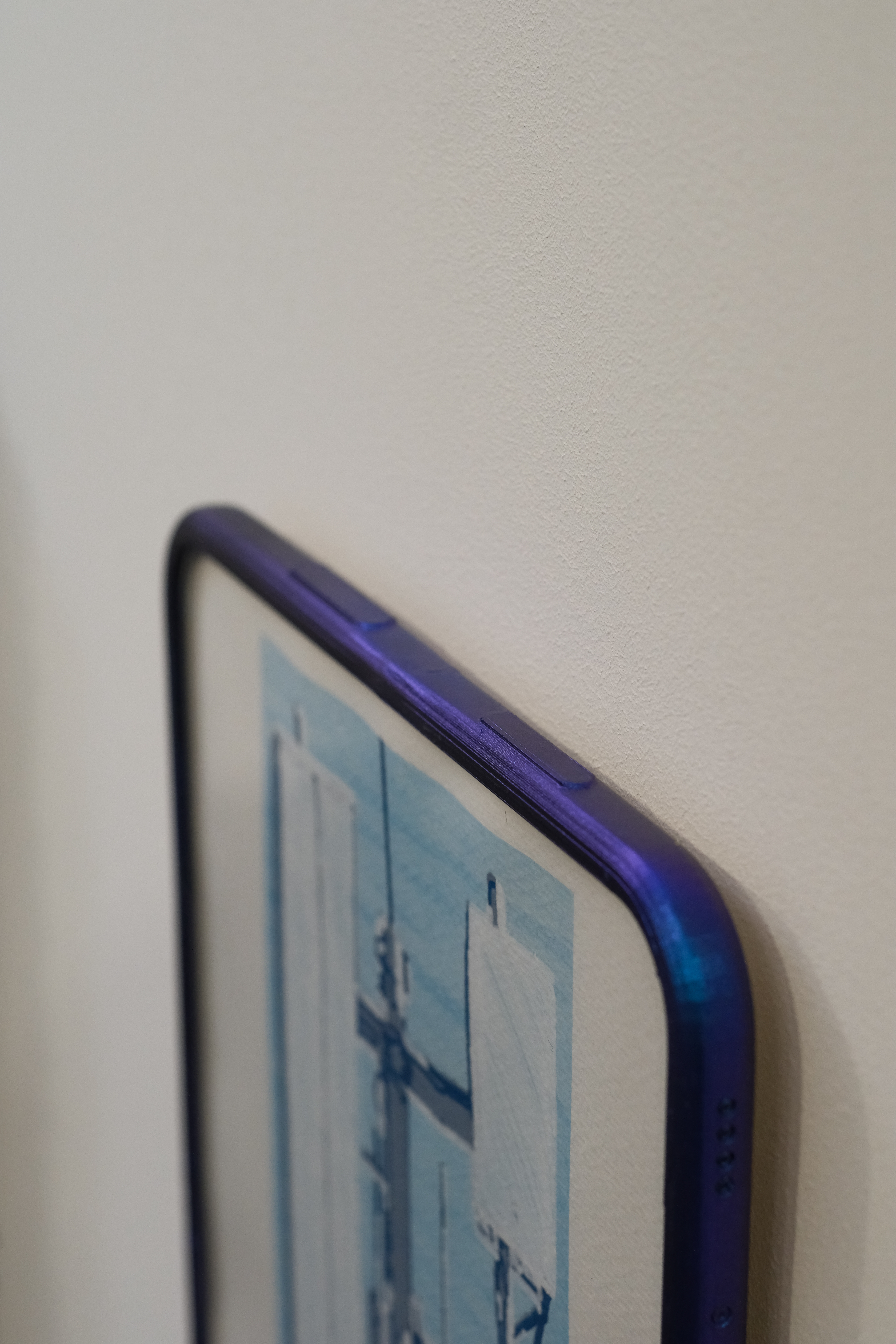
The second image ended up being done on the drawing machine too, sort of because I kept putting off getting a photo printed until I realised I’d better make it myself and continue the colour scheme. The choice of image as previously mentioned was of cell antennae from a photo taken of Sanderstead telephone exchange, closely cropped to continue the aspect ratio and give a sense of body and tightness to the image. The frame for this was tricky, I had created a blobby version of the bodies which I thought might represent “signal” but was unconvinced by my own design. After a period of reflection, I thought about phones, but wouldn’t be able to make or print in time something that would satisfy until I thought about the iPhone Duo, which I had believed was already released at that point, but in fact released the same day as the Manifold 3.0 opening. It seemed to fit with my use of iPads before, with Apple being the hardware manufacturer epitome of zeitgeist representation of technological consumption.
I rushed to finish the two frames, sand and glue them together and then paint them with this lovely iridescent purple automotive paint. And so here they are:
These themes of body, digital process, and our relationship to AI and internet networks seem to have carried me for a few years now, and are certainly the heavy focus of my artistic attention going forward. In the coming months I hope to get a bit more on top of all the admin side of my art practice such as updating my website and this blog to be concurrent rather than just retrospective to my life.
I’m also digging the frame-making, the drawing machine explorations and the more dumb sculpture. The idea of producing objects and images as results of process has I think been the true interest of my practice, more than installations and interactive works, though I’m sure they’ll pop up too. With the new space I want to be able to get through experiments and explorations more quickly, with more impetus to hopefully be able to apply for opportunities more freely with ongoing work instead of imagining a project to fulfill that then takes time to propose and ultimately is left rejected.
It has been an incredibly vibrant year for me, but also with its difficulties and at many times overwhelming. I was a lecturer! I taught a module on Social Media, Crowdsourcing and Citizen Sensing, taking over from the incredible Dr Dan McQuillan who taught the critical AI module I audited a couple of years ago. I also taught the core module for the second year DAC students. It was an extraordinary, humbling, and gratifying experience to be able to spend a year tutoring them, and I hope every one of those students goes on to do fabulous things, which I’m sure they will. _threadsafe got funding! We went back to Portugal and hung 100m of paper for people to take a relief rubbing of an ancient city wall, and I designed it, the system to hang this huge participatory public artwork. We wrote and published a book! Miso and I squeezed all the thoughts out of our heads about exhibitions in domestic spaces, not just about practicalities but deepening into the philosophy of it all and what these spaces represent, what art in them does to us as people and how important the home is as a cultural sphere. And we released it to a packed room of an audience of 90 at REFERENCE.POINT at 180 Strand. Please check the book out and pick yourself up a copy!
For the coming year, I am hoping to reflect and consolidate my practice. I think there is direction. Things have been cropping in for years, but I feel the same few subjects have been aligning for a while. I hope I can work them out in my head to be able to write some more theoretical posts in this coming time. See you soon x


Leave a Reply