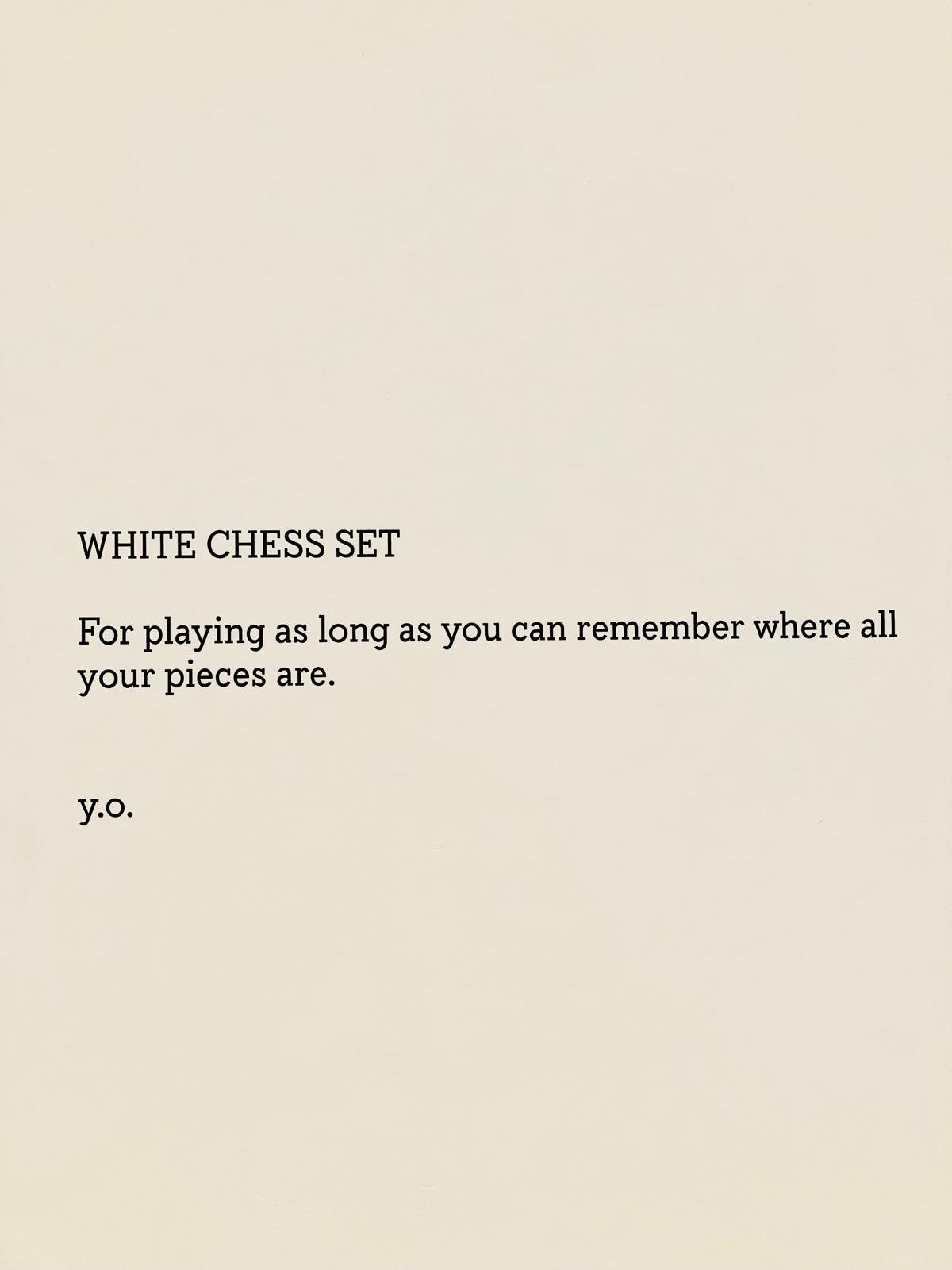
“You’re overthinking it”. That’s what a woman said to me when I sat playing White Chess Set (1966) at Yoko Ono’s Tate Modern retrospective Music of the Mind. It’s a lot to unpack. Can you overthink conceptual art? I’m inclined to think yes. Can you over-question it? I’m not so sure. The teeth of this statement were in relation to a thought I was unpacking about the nature of White Chess Set and the instructions given to it: “Chess set for playing as long as you can remember where all your pieces are”.
Yoko Ono (b. 1933) needs little introduction. A Japanese megastar of 20th century performance and conceptual art, she was a prominent member of the Fluxus movement, changed how we view performance and an audiences relationship with performers and the art, and married a Beatle. She has spent more than half her life campaigning for world peace, and now I’m going to spend 3000 words having a go at her for it.

White Chess Set was laid out as several tables in an area of the show dedicated to her efforts towards achieving world peace, and maybe I’m not getting it but to me the instruction and the setup of chess isn’t about peace at all. As you might have guessed, the key conceit of the work is that all the pieces and all the board squares are white.
There is a clear superficial reading of this work:
“Queen to E5”, Paul says, triumphantly. Ringo nervously scratches his chin,
“White bishop takes, err, white pawn”, he says as he picks up the pieces indicated and makes the replacement.
“Haha, was that my pawn or yours, Ringo?” Paul guffaws a bit too loudly, hoping to conceal that he knows it’s his pawn and Ringo has him on the ropes.
“Oh no, they’re so indistinguishable, I’m starting to get confused”. Ringo hadn’t wanted to play in the first place and is hoping they might agree to a truce.
“Perhaps we should stop, I think the paint is starting to come off” Paul says with a little sigh of relief.
Later that day, John tore into the studio, “Which one of you’s has got your grubby paw-prints on Yoko’s chess set?” Paul and Ringo look to each other guiltily, before George strikes up, “O No!”
The end, thank you for reading my fan fiction.
The thread I want to latch onto is that of the idea of peace within this context, with the given instruction and the format of the game of chess, peace is not directly what is approached by the work. Whilst the superficial sameness of the sides provides an easy connection, and an emergent breakdown of adversarial intent as a result of the game, I believe to consider this “peace” to be a naïve conception of peace, leaving a shallow comment on the nature of conflict. As such this work manufactures or at least perpetuates conflict and it does so through a naivety on the nature of conflict and the nature of chess, leaving itself naïve to its own thesis as an artwork.

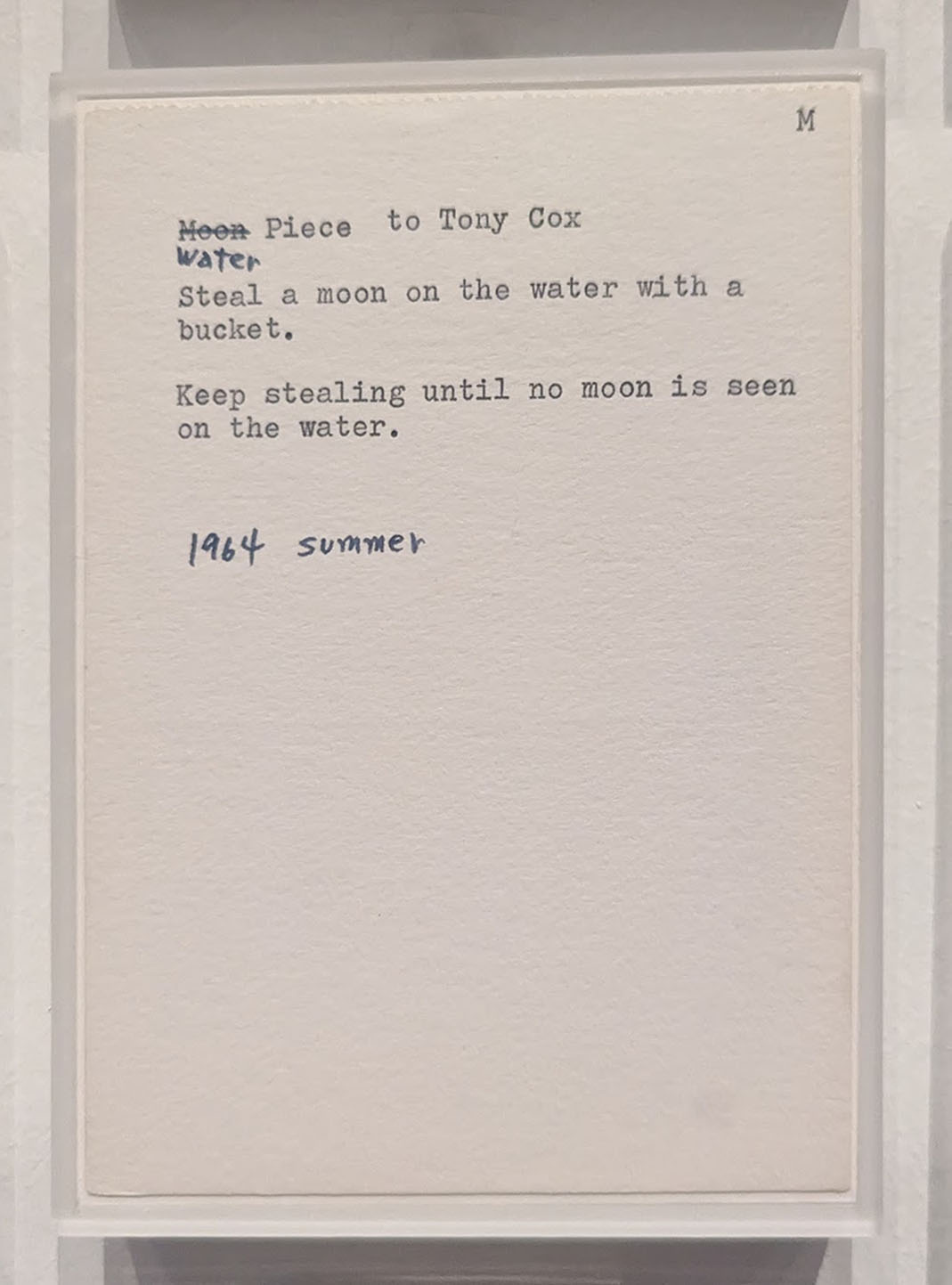
Yoko Ono talks of her works as being an “elephant’s tail”, that the thing you see is a tiny aspect of a work completed predominantly in the mind. To question the open-endedness of her work leaves one feeling vulnerable to accusations of anti-intellectualism, just not getting it by feeling a lack of structure, a surrender of intent. I would like to proffer that I love the beauty in her poetic instructions from Grapefruit, in moonWater Piece to Tony Cox, we are asked to steal the moon from a pool of water. How evocative is that?
I think the very same thing that makes Grapefruit often an astonishingly beautiful and self-reflectively insightful work, a stream that runs through all her work, it’s poetry, suffers on pieces such as White Chess Set and Add Colour (Refugee Boat). Notably these are both socially participatory works (If her works are “elephant’s tails” then all her work is participatory), and perhaps that has an impact, their accessibility, their openness, their universality being the driving factor behind their lives as artworks of conflict.
Interactive artwork is an exercise to some extent or other on user experience design. Instructions, their lack of, or intuitive implied interactivity are crucial in designing the conceptual space within which the artwork acts. And in White Chess Set the instructions are “Chess set for playing as long as you can remember where all your pieces are” and the space is the relatively universal cultural square of chess.
Chess is a game almost every westerner (and I’d go so far as to say almost everyone in the world) has heard of, and most have played a game at least once, and know the basic rules. We have embraced it into the English language, chess metaphors pop up all the time (“checkmate”, we’re playing checkers, she’s playing chess). It is a game synonymous with intellectualism, and was used as a famous marker for computing when Deep Blue beat Kasparov. And so, I bring about the point that this game is so well known and played that this loss of position by mixing of pieces isn’t in fact an inherency in the artwork, but a skill issue of the players. After a point, being able to see the board state isn’t as much a case of looking at the pieces and gaining information, but of having a map of pieces and possible future board states in one’s head. People can play chess without a board, after a point, remembering whose pieces are whose isn’t much of an issue.

Okay this is pedantry, and it’s not common someone might be able to do that. So why do I think this is a work about conflict and not about peace? Play until you can’t remember where all your pieces are; Fight until you can’t remember who you’re fighting. That feels like the sentiment of a first world war soldier. The work is challenging you to play chess, the game adversarial as it is. Ono fosters division by assigning ownership as applies to the standard game of chess, and dares you not to forget what’s yours and what’s your opponent’s, and seeks the joy of your collective confusion when you find it is difficult to play. In doing so it sets out from the premise of conflict, and it doesn’t suggest a path to peace, but is reliant on confusion of battle lines to make peace inevitable. Functionally within the confines of the chess board, this might lead to the game ending as two players agree they cannot continue, but this is stalemate, not peace, it isn’t a resolution, merely abandonment.
Conflict is never superficial, and abandonment is not peace. Superficial differences are brought up, and used varyingly and multitudinously to whip up anger and public backing for conflict, but conflict itself is about land, about money, trade, resource, workforce, greed. Conflict is bred from material difference, difference in conditions, in wealth, in health, in freedoms, and the ripples of these leave tensions within our societies, ruptures that spread and tendril out, often from conflicts that alter the balance of these differences in a perpetual cycle. Our internal conflicts are again seldom so superficial and can be localised to those tendrils of grand scale rupturing of our societies. I don’t write this to dismiss and explain away a suicide, a mugging or an invasion but to suggest that it is possible to trace how the probability of such things well up as a result of material conditions read over generations or even millennia in some cases. And it is in clarity, not confusion that peace can be wrought.
What I think lies in a chessboard of monochromatic pieces is the opportunity for a different game, a collaboration. If we take from this work that the conceit of chess is that the pieces are differentiated by their colours and banners, their standards and flags, then geography is nothing. Why look at the game as a conflict at all? Why begin with any intention of domination? Of a win/lose binary between players? The pieces, their uses, the purpose, the end goal can all be transmuted into a different game. If by the end I’m meant to have lost track of my knight, why wait? Our knights are the same, so let us begin like that and I’ll move pieces in the starting line nearest to you, if I like. If I were to try and take your king, how could I? The kings are identical, sure we might know or guess where they started, but how can it be your king, if it could just as easily be my king? And the rules of movement in the game don’t allow me to put my king into check, or to take it, so that must not be a possible move.

This is a bit of a quantum leap, a magic trick. The spoilsport not playing the game, why not say no pieces have rules, why not x,y,z. And that is where an elegance in White Chess Set comes out, its basically saying to you “You know how to play chess, so play and talk about why this conflict matters”. It certainly is providing a space for conversation about all these aspects I’ve been mentioning, within a comfortable and understood space that has had only one familiar aspect altered. But the instructions provided by Yoko Ono do ask you to begin as you would with any other chess set, to address the work from the point of view of a chess game, and to begin from the inflection of an adversarial relationship with the person opposite you.
The work of art might predominantly be in the mind, but this work doesn’t ask you to consider chess, or suggest any way in which you should approach this other than by attempting to play normally. There is a relational aesthetic at play here, Ono is creating a space in which a belligerent arrogance such as myself can have an epiphany that a wide eyed and open-minded child could be having 5 feet over, (just they don’t have a blog and said arrogance to write about it) and so there is a greater space beyond the table in which this artwork is operating. Yes, and no. A carpenter is not responsible for all the thinking done on the chair they made. I return to the instruction given. The artwork is naïve of its own comment on chess and is stuck in its reliance on the mind-state of a game that already exists. Why abide by the objectives of a game of war, when searching for peace?
When playing we devised to approach a different game, not about conflict, but negotiation. To make a beautiful board state. Pretty patterns, or shapes, or connections between pieces, however it is to be defined. There’s almost no game at all. Many would argue there is none, since there’s no winning, and through communication two people could just contrive to manoeuvre pieces into places they wish. So we put some constraints in: Pieces can only be taken by agreement of the other party (Under Ono’s conception, toward the climax, you couldn’t be sure it wasn’t your piece, so you must have to agree it wasn’t), and no talking (though we weren’t good at this). The point of the latter is to try and work within the mind-state of chess, a fabric where you try and tighten and loosen the board to manipulate the play in your favour, but this time that is not to remove pieces and take the king, but to make the board more beautiful. Pieces must move the same, and there is still directionality, I can only move a pawn away from me by 1 square for example (But the collaborator could then move it back the way it came).
It was a fun exercise and one that could get stale I’m sure, but the goal is peace and agreement, not merely an inability to keep fighting. It is a more nebulous endeavour too. When playing chess, you know also your opponent’s aims, offence and defence are equal so prediction and mind-reading are an essential part of the game. In the version we played, mind reading wasn’t so easy, as the other person’s aims and ambitions weren’t so clear.

I am by no means the first person to come to the conclusion that the point is not to fight, nor that the goal should be to find an agreeable board. The woman who declared I was overthinking the piece said as much. We were suddenly surrounded whilst playing, and I was talking to Miso about my thoughts on how, why, what we were doing by beginning at the point of indifferentiation between the pieces we controlled. So I spoke more to the audience, than just to her, and perhaps in doing so showed my arrogance at proclaiming I had seen the truth beyond the work of Yoko Ono, to which I was met with, “I think you’ve got the point”. I still contend the instruction “playing as long as you can remember where all your pieces are” asks you to begin adversarially, rather than in collaboration, and this is where I believe the work fails itself in not realising the power of not playing the game that is placed in front of you.
Tate Etc 60: Choose Your Own Adventure Yoko Ono
White Chess Set, which was also first shown as part of Ono’s show at Indica Gallery, consists of a white chess board and a set of all-white chess pieces. The work invites viewers to play a game in which the two players’ pieces are indistinguishable from one another. As the score states, this is a ‘Chess Set for playing as long as you can remember where all your pieces are.’ It might just be possible to play, but it becomes extremely challenging. In this way, White Chess Set nullifies the traditional rules of the game – and the idea of opponents altogether.
MOMA: Notes on Yoko Ono’s White Chess Set
As a result, players must take care to remember where they place their pieces as the game unfolds across the board, but it becomes increasingly difficult to differentiate sides as the pieces come into closer proximity; ultimately, players lose track of which pieces are theirs and which belong to their opponent. At this point, outside of Ono’s instruction to discontinue play, players can choose whether to continue attempting to follow the standard rules of chess or create a new way to play together. This process of decision making creates opportunities for conversation, collaboration, and creativity in developing a novel strategy. This aspect of the work suggests Ono’s anti-war stance—an ideology that permeates much of her oeuvre. The artist’s subtle modifications to the game of chess—traditionally considered a war game—fundamentally alter the goals of playing; instead of working against one another as if in battle, players must work together to effect conditions of peace.
The MOMA article goes on to mention a woman who’d play only if pieces were not taken, turning the board into a site for discussion. I wish to take all this one step further and begin as we meant to go on, with all pieces available to all players from the start, to begin the same, with all the pieces accessible to all the players all the time, not solely at the moment of confusion, as I’ll repeat, confusion isn’t peace.
I saw many of what I thought be self-defeating works at the show, that appeared to lack the conviction of the message they presented. A commonly criticised moment of her peace-career is the bed-in with John Lennon, where they stayed at the Amsterdam Hilton, and whilst I love its lines in The Tale of John and Yoko, “The newspapers said, what are you doing in bed? / I said we’re only trying to get us some peace”, the photo of the hotel maid changing their bedsheets is damning. I believe Yoko Ono to be a pioneer, I am not cynical towards her work, her aims, her advancements in performance and conceptual art, her desire for world peace. But I am sceptical about the conviction in her work sometimes, in the understanding of the messages rooted through it all not just its surface-level readings.
A work where this lack of conviction is visible (which I own is something I see, this doesn’t need to be true, it can be my projection onto her work), but that it in itself creates a deeper context to the work is in Cut Piece (1964). In the excerpt from the 1965 performance of this piece at Carnegie Hall, Ono seems to lose control of the situation and a real panic takes over her face as she attempts to remain neutral. This happens when a man cuts away her undershirt, and then cuts her bra straps. Yoko holds her bra to herself, preserving her dignity, making a gesture that speaks to this being an incredible piece of feminist art. The work invites the audience to cut away at her with provided scissors. They take snippets of cloth from her garments, and there is a clear disparity between the male and female participants. The women often take small squares of cloth, whilst the men act to undress the artist, ultimately culminating in a male cutting away at all the support of her clothes. My critique may be just plain wrong and my analysis unfounded, as it centres on this document of one performance of a work that had been exhibited in Japan the year before, and has been performed many times since, but I read into that facial expression that these aren’t the expected interactions and outcomes. I cannot find a definite instruction given to participants for the work. Was it simply to cut? To cut clothes? How far did that instruction go. In such a way I wonder where the possibility of its end went for Ono when first performing? Did the auidience stop when they’d each had a go? When she was naked? Some point before then? Did anyone cut her? I see in the panic in the Carnegie Hall performance, that perhaps this wasn’t expected to go so far as nakedness. Or perhaps its the actual man doing those last cuts that she’s panicked by. Maybe I’m overthinking it.
As has been noted by other writers, this work is like watching a sexual assault take place, as an audience member we are violators. Ono presents herself for inspection as an object, something to be done to rather than someone to be done with. She creates a tension between her as a performer and the stage as a place for performance and the audience who must act in order for the performance to occur. Ono isn’t placid though, she preserves herself, she cannot see herself as an object within this piece, she must retain her dignity in her femininity. Other photos of the performance also suggest she hides her breasts when they would be exposed. It reminds me of the Fela Kuti song Fefe naa efe: “It is because of her beauty which is why a woman holds her breasts when she runs, not because the breast is going to fall”. Her doing so makes the whole performance feel like a violation, she shows she doesn’t wish to be an object, that she cannot be not a woman, not a person.

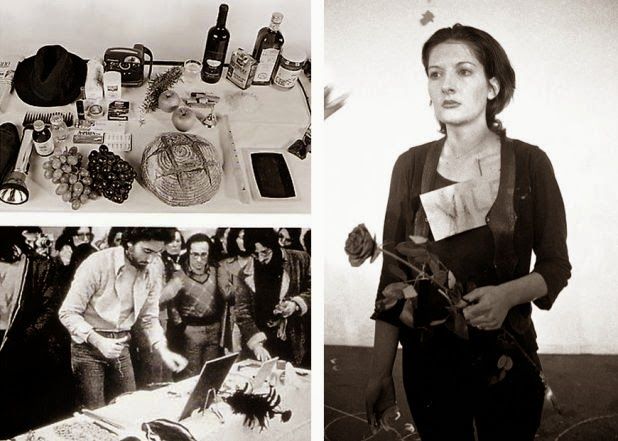
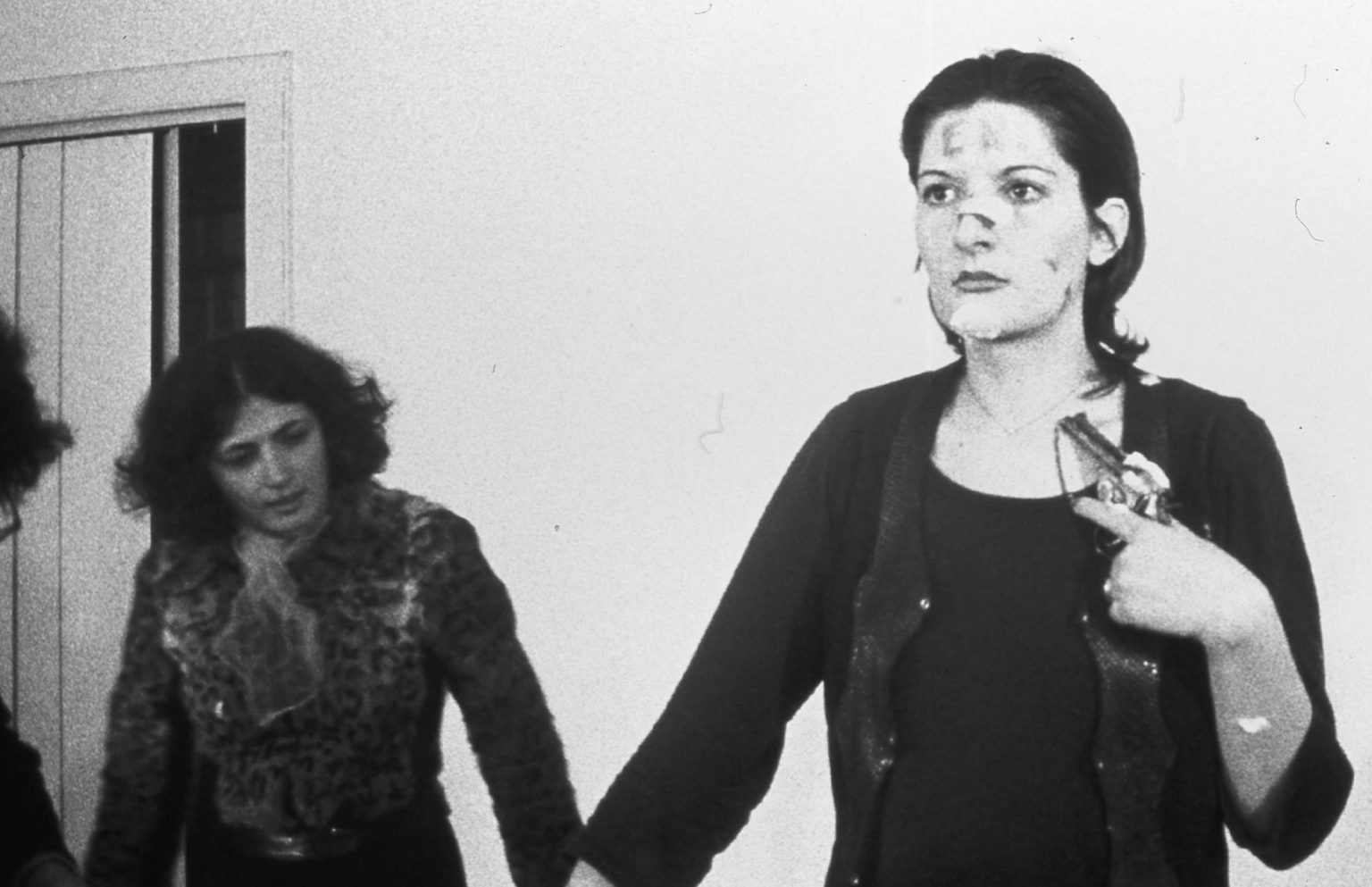
The work stands (or sits) in contrast to Marina Abramovic’s Rhythm 0 (1974). Ten years after Yoko, Abramovic offered the audience 72 objects and 6 hours of her as an object. Abramovic dares the audience to treat her as an object. Stripped, cut, sexually assaulted, her murder was only stopped by audience members factionalising. Yoko Ono walked so Marina Abramovic could run, and I think makes a sharper critique on gender relations, by reclaiming her identity during the piece, rather than reclaiming her personhood when the piece ends as Abramovic does.
A final work I’d like to explore a brief observation of took place near the end. Audiences drawing on walls isn’t new for contemporary art, and I can see why museums love it, participatory, instagrammable, social, it’s fun! Yayoi Kusama allowed us to put stickers on things, now Yoko Ono has let us draw in blue in Add Colour (Refugee Boat) (1960, first realised 2016). It’s wonderful, you walk into this blue-bottomed room and marvel at how some marker pens and thousands of people have combined to install the ocean into a gallery. There’s a strangeness in the noise though. Inside this symbol of humanitarian aid/crisis, people put their political slogans, write messages commonly, draw symbols and otherwise express themselves freely as they should. But it brings up conflict. I saw many instances of “Free Palestine”, and then in front of me a woman writing furiously in many places “free the hostages now”. Despite these both being messages wishing for a more peaceful world, their juxtaposition is in conflict. This site of oceanic noise is full of conflicts, and perhaps this washes away. If you want to take an enlightened overview stance, then peace is created through the noise, and the catharsis of writing on walls these conflicting thoughts can act as a meditative process to bring about a togetherness. I’m not sure I believe in that, and I think people are petty enough to take this to heart and find conflicts and outrage within collective spaces.

And some people find criticisms in works made for fun social engagement, that is accessible and enjoyable for the masses in an environment that promotes thought, and self-reflection as well as entertainment. I’d like to return to my position that I am a great admirer of Yoko Ono, as a person, as an artist, a general creative and campaigner. She presents the world sideways and has always done so against the grain of a world that would have taken issue with her as a Japanese woman, as well as dealing with the fallout of celebrity culture, often unfairly being blamed for breaking up The Beatles. I could write platitudes about many of the works that did delight me in Music of the Mind, but the ones that get under my skin are those that develop deeper contemplation, and White Chess Set really sparked something in me. So let me end on joy, artwork has a place for humour.

 Robin Leverton
Leave a comment